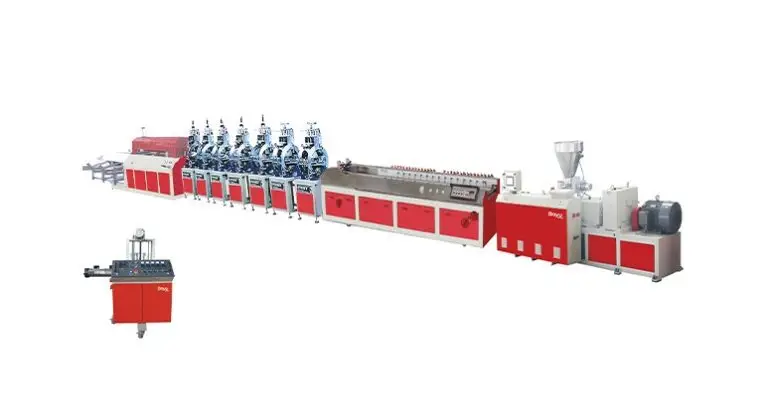
Capital expenditure planning for a new extrusion project involves much more than comparing equipment quotations. For manufacturers entering PVC profile production, the investment must cover the complete production system, utilities, installation, automation, tooling, and commissioning. We recommend evaluating each cost category according to its contribution to output, quality, and long-term operating stability. A well-planned PVC profile production line should therefore be viewed as an integrated manufacturing asset rather than a collection of individual machines.
Start with the Core Extrusion Equipment
The largest portion of CAPEX normally goes toward the main production equipment. A modern PVC profile extrusion line needs coordinated equipment for melting, shaping, calibration, traction, cutting, and handling. The exact configuration depends on the profile design, dimensions, material formulation, target output, and automation requirements.
At Boyu, our PVC profile solution is designed for continuous and stable manufacturing of products such as wall panels, siding panels, and decorative profiles. Our published product information emphasizes high-precision profile extrusion, stable output, dimensional accuracy, and customized configurations.
For project budgeting, buyers should request a complete equipment list rather than evaluating only the extruder price. This helps prevent important auxiliary equipment from being overlooked during the initial investment calculation.
Extruder and Forming Section
The extruder is a central CAPEX item because it determines how effectively the selected formulation can be processed. Screw configuration, motor power, throughput, temperature control, and mechanical construction all influence the appropriate investment level.
Our published PVC profile information lists three SJSZ configurations: SJSZ-48/51 with a 15 kW main motor and 120 kg/h capacity, SJSZ-55 with 22 kW and 150 kg/h, and SJSZ-65 with 37 kW and 250 kg/h. These figures provide practical reference points when matching equipment capacity with planned production demand.
The forming section is equally important. The T-die and downstream calibration equipment must maintain the required profile geometry after extrusion. Investing appropriately here can reduce dimensional variation and quality losses.
Tooling and Product Flexibility
Tooling should have its own place in the CAPEX plan. PVC profiles can have substantially different cross-sectional geometries, wall structures, dimensions, and surface requirements. A manufacturer producing several profile families may therefore need multiple dies and related tooling.
We recommend calculating tooling costs according to the initial product portfolio rather than purchasing every possible configuration at launch. This approach allows manufacturers to prioritize high-demand products while preserving capital for future expansion.
Our PVC profile production line can be customized according to profile design, production capacity, and automation level. This flexibility is particularly relevant for business manufacturers whose product mix may evolve with customer requirements.
Automation and Electrical Systems
Automation represents another important CAPEX category. PLCs, temperature controllers, drives, sensors, operator interfaces, and electrical cabinets influence how accurately operators can control the production process.
A higher level of automation may increase initial investment, but it can also support consistent operation and simplify process management. Our PVC profile solution emphasizes precise control and stable production, while Boyu‘s broader equipment portfolio includes automation options from established industrial component suppliers.
When comparing quotations, buyers should verify exactly what is included in the electrical and control package. Otherwise, apparently lower equipment prices can become less attractive once missing automation components are added.
Utilities, Installation, and Factory Preparation
A machine quotation does not represent the entire project investment. Manufacturers also need to budget for electrical infrastructure, water systems, compressed air where required, ventilation, material preparation, foundations, transportation, installation, and commissioning.
These expenses vary significantly between factories, so they should be calculated according to the actual production site. Utility requirements should also be confirmed before equipment ordering to prevent costly modifications after delivery.
We provide installation guidance, commissioning, operator training, and technical support for our extrusion solutions. Including these services in project planning can help buyers understand the complete transition from equipment delivery to commercial production.
Working Capital and Contingency
CAPEX planning should also leave room for costs surrounding the equipment investment. Spare parts, initial tooling adjustments, testing materials, packaging arrangements, operator training, and commissioning-related consumption can affect the amount of capital required before stable sales begin.
A contingency allowance is particularly useful for international projects because transportation, site modifications, and installation conditions can introduce unexpected expenses. We recommend separating these allowances from the equipment quotation so project teams can clearly distinguish supplier costs from internal implementation costs.
The goal is not simply to minimize the initial purchase price. It is to establish enough financial room for the line to reach stable production without compromising essential equipment or support.
Building a Practical CAPEX Model with Boyu
A useful CAPEX model should divide investment into core extrusion equipment, tooling, automation, utilities, installation, commissioning, and contingency. The percentage assigned to each category will vary according to product requirements and factory conditions, so generic percentages should be treated only as preliminary planning references.
For buyers evaluating a PVC profile production line, production capacity deserves particular attention. Our published models cover 120–250 kg/h, allowing manufacturers to consider different output levels instead of automatically selecting the largest available system.
We focus on matching equipment configuration with actual product geometry, order volume, formulation, and precision requirements. Our wider manufacturing capabilities include a 30,000 m² facility and more than 120 extrusion-technology patents, supporting our approach to high-precision extrusion engineering.
A modern PVC profile extrusion line should ultimately be evaluated by its total project value, not its purchase price alone. By identifying every CAPEX category before ordering, manufacturers can make more informed investment decisions, avoid hidden costs, and select a configuration that supports reliable production. We work with customers to align equipment selection, customization, and technical support with their production objectives, creating a stronger foundation for long-term manufacturing performance.