
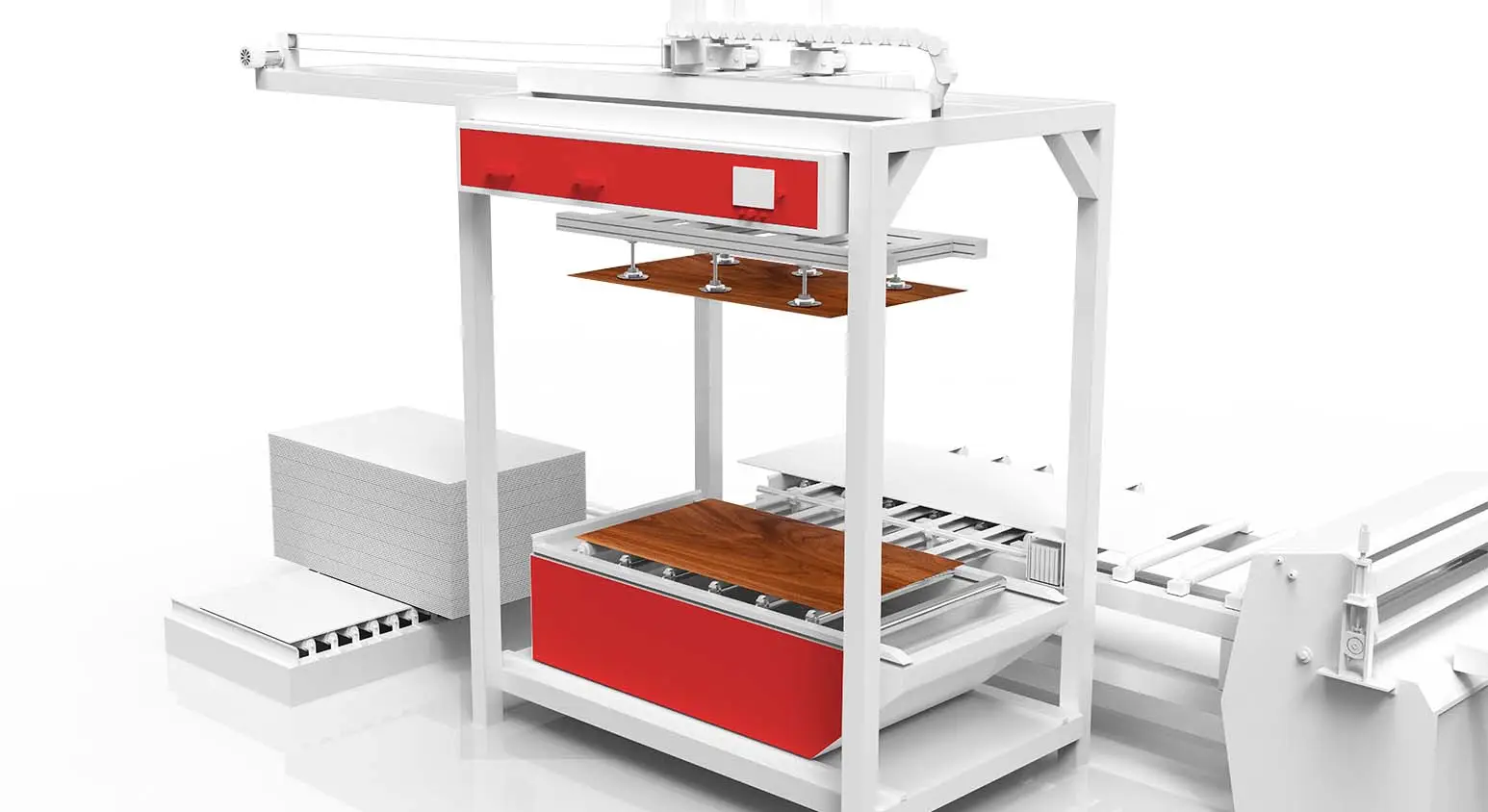
Consistent SPC flooring depends on more than formulation and extrusion capacity. For manufacturers, the thermal performance of machine components directly affects process stability, maintenance, operator safety, and product consistency. We therefore treat heat resistance as a system-level consideration, covering the hot processing zone, mechanical transmission, electrical controls, and temperature monitoring. This helps buyers evaluate equipment against actual operating conditions instead of relying on a single label.
What Heat Resistance Means in SPC Production
SPC flooring commonly uses PVC powder, calcium carbonate, stabilizers, lubricants, and other additives. During extrusion, the compound is heated and plasticized before it reaches the T-die and downstream forming equipment. The temperature exposure is therefore concentrated around the extruder, die, and calendering area, while bearings, drives, wiring, sensors, and control components face different thermal conditions.
There is no single international temperature rating that defines every component of an SPC line. Instead, buyers should examine the operating temperature, material limits, insulation class where applicable, sealing performance, lubrication requirements, and safety design of each component. ISO’s plastics machinery committee is currently developing ISO/CD 22506 specifically for extruders and ancillary equipment, covering essential safety requirements throughout the machinery life cycle. This distinction in safety standards is important when comparing suppliers.
Heat-Exposed Components Need Different Protection
The extruder is the primary thermal zone. Its barrel, screw, heating system, and related interfaces must withstand repeated heating and cooling cycles while maintaining stable processing conditions. The T-die is also exposed to elevated temperatures because it shapes the molten material. For an SPC flooring extrusion line, dimensional stability and reliable temperature control are essential because fluctuations can affect melt flow and sheet uniformity.
Downstream components require a different strategy. Calenders and traction systems work close to the heated sheet, but their bearings, electrical devices, sensors, and transmission parts should not simply be treated as high-temperature components. Their allowable temperatures depend on the selected component design and installation environment. Good engineering therefore combines heat shielding, ventilation, suitable materials, correct lubrication, and controlled spacing from hot surfaces.
Electrical and Control Systems Matter Too
Thermal reliability extends into the control cabinet and field wiring. IEC 60204-1 addresses electrical, electronic, and programmable electronic equipment used on machinery and sets general requirements for machine electrical systems. For buyers, temperature management should be considered alongside wiring, controls, and emergency functions.
We specify PLC and control options according to the equipment configuration. Boyu’s SPC line uses PLC-programmed touch-screen control, with Omron or Siemens available for the PLC, Schneider low-voltage electrical components, and Inovance, ABB, or Siemens frequency inverters. These are published configuration options, not blanket claims that every component is rated for the same temperature.
How We Build Thermal Reliability Into an SPC Flooring Extrusion Line
At Boyu, we design the line around stable processing and coordinated equipment. Our published SPC configuration includes an extruder, T-die, calender, traction machine, cutting machine, and automatic flipping and stacking system. The line is designed for PVC powder, calcium carbonate, stabilizer, lubricant, and small materials, with published product widths of 1050/1350 mm and thicknesses of 3–9 mm.
We also match thermal management to production requirements in the SPC flooring extrusion line. The published operating condition is 380V/3 phases/50Hz with DC24V or customized options, while capacity varies by model. For example, the SZJZ-80 is listed at 6–8 tons per 24 hours, and the SZJZ-180 at 70–100 tons per 24 hours. These figures show why component selection should match throughput, formulation, and duty cycle.
What Buyers Should Verify Before Ordering
When evaluating an SPC flooring production machine, we recommend asking suppliers for component temperature limits, electrical component specifications, bearing and lubrication requirements, insulation details where relevant, and the location of temperature sensors. Buyers should also clarify how alarms, shutdowns, and over-temperature protection are integrated into the system.
Documentation is equally important. CE certification is listed for Boyu’s machine fabrication and electrical components, while the company identifies its transmission bearings as Chinese mature brands or NSK/SKF options. Such details give procurement teams concrete points for technical comparison and maintenance planning. They are more useful than an unsupported claim that an entire line is simply “heat resistant.”
Why Thermal Stability Supports Long-Term Production
Heat management has a direct relationship with uptime. Excessive or uneven temperatures can accelerate component aging, affect lubrication, destabilize electrical equipment, and increase maintenance requirements. Conversely, properly selected components and controlled thermal conditions help the line maintain repeatable operation.
For business flooring manufacturers, this matters because consistency must be maintained across long production runs. A reliable SPC flooring extrusion line should be assessed not only by headline capacity, but also by thermal control, component quality, automation, serviceability, and suitability for the intended formulation and schedule.
Making Heat Resistance Part of Equipment Selection
We believe heat resistance should be evaluated as part of a complete engineering specification, not as an isolated marketing term. The right approach considers each heat-exposed zone, verifies component limits, and connects temperature control with mechanical and electrical safety requirements.
Boyu combines stable extrusion, intelligent control, and configurable components to support industrial SPC flooring production. Our SPC flooring production machine options include different models and published capacity ranges for the SPC flooring production machine, allowing buyers to select a configuration that matches their manufacturing objectives. By treating thermal reliability as a purchasing criterion from the start, manufacturers can make more informed equipment decisions and build a stronger foundation for consistent flooring output.