In foam board manufacturing, the HMI is the nerve center that turns operational goals—consistent output, fast adjustments, and clear process visibility—into daily reality. That is why Boyu designs its extrusion systems with the operator at the core: we treat the human-machine interface not as a peripheral screen, but as the bridge between people, controls, and production data.
To deliver that bridge, our systems employ PLC-programmed control with Omron or Siemens PLC options, paired with mature Chinese or Siemens touch screens for intuitive, real-time management of continuous production.
A Clearer Control Center for Daily Production
We know operators need to make decisions quickly when running a continuous line. A modern HMI can consolidate key operating information into an accessible interface instead of requiring personnel to interpret separate instruments. For our PVC foam board extrusion line, PLC-based control supports coordinated operation across the extrusion and downstream equipment.
This matters when production teams handle different board widths or thicknesses. Boyu specifies board widths of 915, 1220, 1560, and 2050 mm, with thicknesses generally ranging from 5 to 20 mm depending on the configuration. Showing operating settings clearly helps teams verify that the machine is running against the intended production target.
Faster Parameter Monitoring and Adjustment
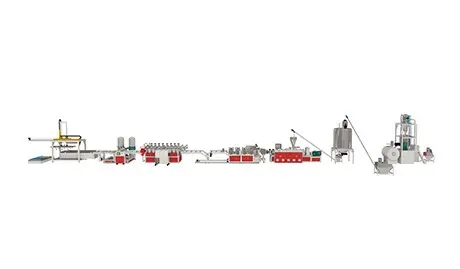
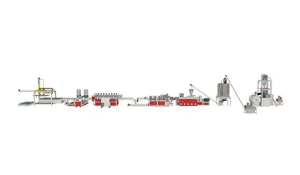
Foam board extrusion depends on coordinated equipment performance rather than one machine working alone. Boyu’s equipment list includes the extruder, T-die, forming platform, 16-roller traction machine, cutting machine, and stacking system. An HMI can make operating conditions easier to monitor across this sequence, helping operators identify deviations before they become larger production issues.
Operators may need to observe extrusion conditions while coordinating traction and cutting. A well-organized interface reduces the time needed to locate a parameter or confirm machine status. This supports more disciplined operation of a PVC foam board production line, particularly when schedules require repeated adjustments.
Supporting Consistent Product Quality
Product consistency is a major concern for business manufacturers because dimensional variation can increase scrap, rework, and customer complaints. Boyu’s PVC foam board extrusion line is designed for stable extrusion output, uniform board density, and precise thickness control. Its published specifications cover multiple configurations, including capacities from 400 kg/h to 550 kg/h for the listed PVC crust foam board models.
HMI improvements can strengthen this process by presenting operating parameters in a structured format. Operators can compare actual conditions with established process settings and respond sooner when readings move away from the desired range. The HMI therefore becomes a practical tool for maintaining repeatability rather than simply displaying machine status.
Better Changeover Management
Production flexibility often requires manufacturers to switch between board specifications. Different orders may call for different widths, thicknesses, or production rates, making clear parameter management valuable. Our systems are offered with configurable electrical and control components, including Schneider low-voltage electrical components and Inovance, ABB, or Siemens frequency inverters.
A more capable HMI can make changeovers easier to manage by organizing settings and machine states logically. When operators can review relevant parameters from one interface, they spend less time searching through controls. This can help reduce adjustment errors and support a more repeatable workflow across production orders.
Improving Operator Awareness and Troubleshooting
A production line becomes easier to manage when operators can understand what is happening without relying entirely on manual inspection. HMI screens can provide a structured view of operating states, alarms, and selected parameters. While exact functions depend on the control configuration, better visibility can help maintenance and production personnel identify abnormal conditions more efficiently.
For our PVC foam board production line, this is especially relevant because the equipment works as a connected system. An issue affecting extrusion can influence forming, traction, cutting, and stacking. Clear status information can help teams narrow down where attention is needed, potentially reducing unnecessary stoppages and supporting faster troubleshooting.
Why HMI Matters for Long-Term Line Performance
HMI improvements are most valuable when they support the broader objectives of an extrusion system: stable production, efficient operation, and manageable maintenance. They do not replace sound mechanical design or process control. Instead, they make the interaction between operators and equipment more practical, helping production teams use machinery more effectively.
For manufacturers evaluating a PVC foam board extrusion line, control architecture should be considered alongside capacity, board dimensions, extruder configuration, and downstream equipment. Boyu’s published line configurations include 400 kg/h and 550 kg/h capacities for PVC crust foam board models, with a 500 kg/h co-extruder configuration also listed. These specifications provide a practical basis for matching equipment to production needs.
Turning Better HMI Design into Production Value
We view HMI development as an important part of making industrial extrusion equipment easier to operate and maintain. Clearer information, organized controls, and better operator awareness can contribute to consistent workflows and faster responses to process changes. For business manufacturers, those improvements can matter across every shift and production order.
Our goal at Boyu is to combine intelligent control with reliable extrusion equipment and practical line configurations. When selecting a PVC foam board production line, we encourage manufacturers to evaluate not only output and product specifications but also how easily operators can monitor and manage the system. A well-designed HMI can turn complex equipment into a clearer, more manageable production environment across demanding industrial operations.