
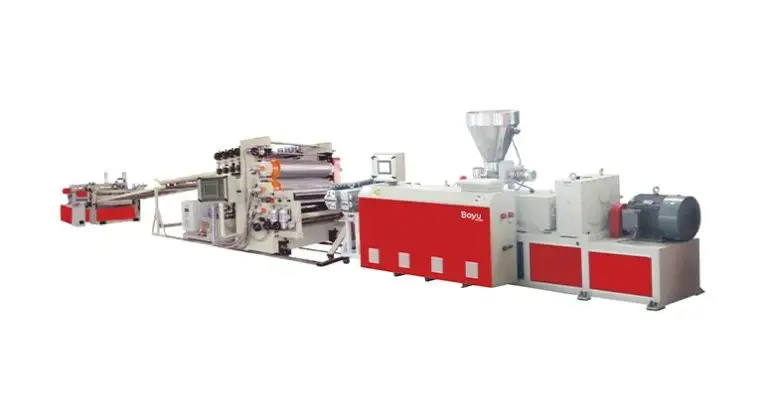
Consistent gearbox lubrication is essential for keeping a continuous extrusion system stable. For manufacturers operating a PVC marble sheet production line, the gearbox transfers motor power to the extrusion process and works under continuous mechanical load. Poor lubrication can increase friction, heat, wear, and unexpected downtime. We therefore recommend treating lubrication as planned maintenance based on operating conditions, lubricant requirements, and the gearbox manufacturer’s instructions.

Why Gearbox Lubrication Matters in PVC Sheet Production
A gearbox contains gears, shafts, bearings, seals, and other moving elements that depend on an adequate lubricant film. Correct lubrication reduces metal-to-metal contact and helps control frictional heat. SKF notes that oil viscosity affects friction in bearings and gear mesh, so lubricant selection should account for actual operating conditions rather than simply choosing a high-viscosity oil.
For a PVC marble sheet machine, stable mechanical transmission is important because the extrusion system must operate continuously to maintain consistent sheet output. The gearbox is only one part of the complete system, but its condition can influence equipment availability and maintenance costs. We therefore recommend including gearbox inspection in routine equipment care.
Start With the Manufacturer’s Lubrication Requirements
There is no universal lubrication interval for every industrial gearbox. The correct schedule depends on gearbox design, lubricant type, load, speed, operating temperature, contamination, and duty cycle. We recommend using the gearbox nameplate, manual, and lubricant specification as primary references before establishing a plant maintenance schedule.
For buyers commissioning a PVC marble sheet production line, this information should be requested during equipment handover. The maintenance team should record the gearbox model, lubricant grade, initial fill, inspection method, and recommended replacement interval. This creates a traceable baseline and prevents technicians from relying on assumptions during servicing.
A Practical Gearbox Inspection Schedule
Daily or shift-based checks should focus on visible conditions. Operators can inspect for oil leakage, unusual noise, vibration, abnormal temperature, or changes around seals and housings. A sudden change in gearbox behavior can indicate a lubrication problem, mechanical wear, or another developing fault that deserves investigation before production continues.
Weekly inspections can include checking the oil level according to the gearbox manufacturer’s specified method and inspecting the surrounding area for contamination. Oil should not be added simply because the level appears low without determining why it dropped. A recurring reduction may indicate leakage or another mechanical issue.
Monthly or scheduled maintenance should include a closer review of lubricant condition, seals, breather components, and gearbox mounting. Depending on the gearbox design and service environment, technicians may also monitor oil temperature or use condition-based analysis. A fixed calendar interval should never override the specific maintenance requirements supplied for the gearbox.
When to Change Gearbox Oil
Oil replacement should follow the gearbox manufacturer’s recommendation, but operating conditions may justify more frequent service. High ambient temperatures, heavy loads, extended operating hours, contamination, or repeated thermal cycling can accelerate lubricant degradation. We recommend recording operating hours and maintenance history so the replacement interval can be evaluated using actual plant conditions.
When changing oil, technicians should use the specified lubricant and quantity while preventing dirt or moisture from entering the housing. Mixing different lubricant types without confirming compatibility can create avoidable problems. The old lubricant should also be inspected for unusual particles, discoloration, or other signs of abnormal wear.
How Lubrication Supports Production Reliability
A well-maintained gearbox helps a PVC marble sheet machine transmit power efficiently and operate predictably. SKF explains that excessive oil viscosity can increase friction and operating temperature in high-speed applications, while insufficient viscosity can compromise the desired lubrication film. This demonstrates why “more oil” or “thicker oil” is not automatically better.
For industrial buyers, lubrication should be considered alongside motor selection, extrusion capacity, control systems, and maintenance access. Boyu’s PVC imitation marble sheet line includes an extruder, T-die, calender, traction machine, cutting machine, and automatic flipping and stacking system. The published configurations include the SZJZ80/156 with 75 kW motor power and 400–500 kg capacity, and SZJZ92/188 with 110 kW and 600–700 kg capacity.
Building a Maintenance Record for Your Line
We recommend creating a simple gearbox maintenance record for every PVC marble sheet production line. It should document lubricant type, oil level, inspection dates, operating hours, temperature observations, leakage findings, and oil-change history. Recording unusual noise or vibration can also help maintenance teams compare current behavior with previous operating conditions.
This record becomes especially valuable when production schedules increase or when the machine operates under different formulations and loads. It gives maintenance personnel a clearer basis for planning spare parts and service work. For business manufacturers, such documentation supports preventive maintenance instead of waiting for a gearbox-related stoppage.
Keeping the Gearbox Ready for Continuous Production
We view lubrication as a basic but critical part of machine reliability. A suitable lubricant, correct quantity, regular inspection, and manufacturer-defined replacement interval can help protect gears and bearings while reducing avoidable maintenance risks. The objective is not to lubricate as frequently as possible, but to maintain the correct lubrication condition for the actual application.
When selecting a PVC marble sheet machine, we encourage buyers to consider maintenance requirements as carefully as production capacity and product specifications. Boyu’s line is designed for stable operation and low energy consumption, with published product widths of 1220/1830 mm and thicknesses of 1–8 mm. A disciplined gearbox lubrication schedule can further support reliable long-term production.