
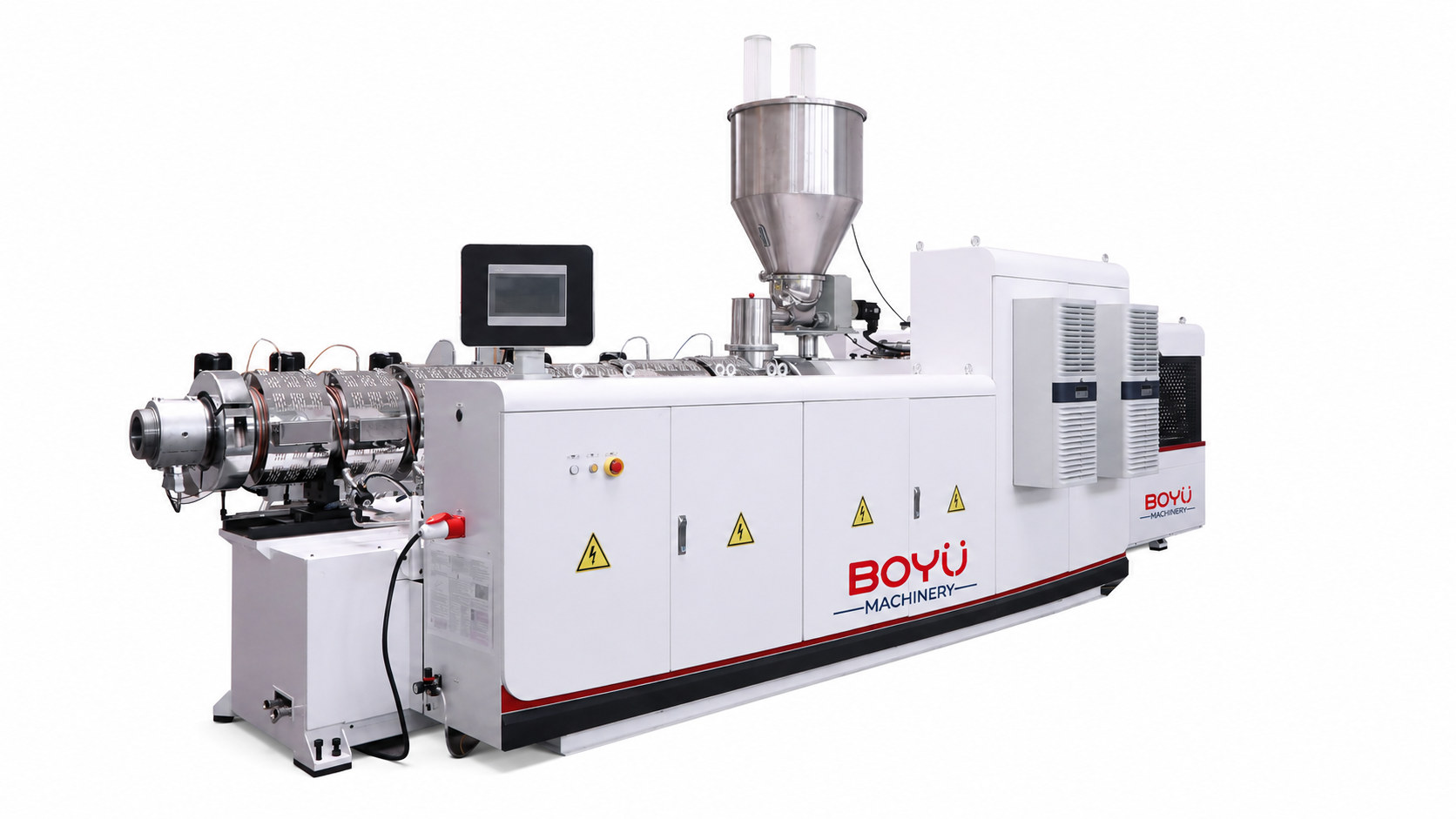
Plastic extruder screw wear develops gradually, but its effects can quickly appear as lower output, unstable pressure, higher melt temperature, and product defects. Understanding why wear occurs—and knowing when to inspect, rebuild, or replace the extruder screw—helps reduce avoidable downtime. This guide explains the main warning signs, inspection points, and practical decisions involved in managing screw wear.
Why a Plastic Extruder Screw Wears
Every extruder screw works against constant friction. Pellets, powders, and fillers are compressed and sheared against the barrel wall as they move from the feed zone to the die, and over time this abrasive action wears down the flight lands, the raised edges of the screw channel that maintain a tight seal against the barrel bore.
As the flight lands thin, the clearance between the extruder screws and barrels widens, allowing material to leak backward instead of moving forward. The result is lower conveying efficiency, rising shear heat, and less consistent output.
What Accelerates Plastic Extruder Screw Wear
Several factors influence how quickly a screw wears, and they don’t act in isolation.
Filler Type and Loading
Filler loading is one of the most direct drivers of wear rate. A formulation with a higher calcium carbonate ratio wears flight lands faster than one with a lower filler ratio, even when the base resin is the same.
Operating Speed and Output
Higher screw speeds and sustained high-volume production increase the amount of abrasive material sheared against the metal surfaces per hour, which accelerates wear even with the same formulation.
Screw and Barrel Material Mismatch
Wear resistance needs to match the actual duty. A screw and barrel specified for moderate filler loading will wear out much faster when the line is later switched to a heavier calcium carbonate formulation, since the abrasive demand on the components increases even though the base process looks similar on paper.
Contaminated or Inconsistent Feedstock
Regrind material or recycled content with unpredictable particle content adds an additional wear risk, since contaminants can be harder and more irregular than the base resin itself.
Six Signs Your Plastic Extruder Screw Is Wearing Out
Because wear happens gradually inside the barrel, it’s often not something you can see directly until you tear the machine down. But the screw usually leaves clues in the numbers and the output well before that point.
- Falling specific output: The same screw speed produces fewer kg/hr than before.
- Rising discharge or melt temperature: Increased leakage over the flights generates additional shear heat.
- Higher motor amperage: At the same throughput, the drive works harder to compensate for reduced conveying efficiency.
- Fluctuating head pressure:The pressure reading becomes unstable instead of remaining steady.
- Visible flight wear or scoring: Wear marks, thinning flight lands, or scratches are found during teardown inspection.
- Product defects: Unmelted particles, surging, or inconsistent wall thickness appear when they were not present before.
Any single sign may have other causes, but two or more appearing together may indicate that the screw-to-barrel clearance has increased beyond the design tolerance.
Regrind or Replace Your Plastic Extruder Screw? A Practical Decision Guide
Once one or more of these signs show up, the next question is what to actually do about it. Not every worn screw needs to be replaced outright—in many cases, a rebuild can restore performance at a fraction of the cost. The table below breaks down wear into three practical stages, along with the action that typically makes sense at each one.
| Wear Level | Observable Signs | Recommended Action |
| Light | Output and pressure are still stable, but motor amperage or melt temperature has crept up slightly compared to baseline | Monitor closely and log readings; no action needed yet |
| Moderate | Output has noticeably dropped, head pressure fluctuates, and visible flight wear or scoring shows up on inspection | Plan for a rebuild before the next major production run |
| Severe | Flight clearance has reached roughly twice its as-new value, or the screw has already been rebuilt about three times, or the shaft is bent or cracked | Replace the plastic extruder screw rather than rebuilding again |
The safest approach is to rebuild a plastic extruder screw while wear is still in the light-to-moderate range, then move to full replacement once clearance nears that severe threshold or the rebuild count runs out.
Either way, always measure the barrel bore alongside the screw, since clearance depends on both parts and a rebuilt screw dropped into a worn barrel won’t restore original performance on its own.
Preventive Maintenance for Plastic Extruder Screws
Replacing or rebuilding a worn screw is a fix after the fact. The more cost-effective approach is to slow down wear in the first place, and catch it early when it does happen. A few consistent habits can make a real difference over the life of the equipment:
- Log motor amps, melt temperature, and head pressure daily to catch drift early.
- Keep a spare screw on hand so a scheduled swap never turns into unplanned downtime.
- Remove hard contaminants from regrind and recycled materials to reduce wear on extruder screws and barrels.
- Work with an experienced plastic extruder manufacturer to determine the appropriate screw design and clearance tolerances during equipment selection.
Why Choose Boyu Machinery as Your Plastic Extruder Manufacturer?
Controlling extruder screw wear depends not only on inspection and maintenance, but also on choosing equipment that matches the actual material and production load. In this context, Boyu Machinery is a plastic extruder manufacturer worth considering for buyers seeking an application-focused extrusion solution.
Broad application coverage: Boyu Machinery offers plastic extrusion solutions for a wide range of finished products, including:
- PVC Profile Production Line: Suitable for producing door panels, wall panels, grille panels, cabinet and wardrobe panels, door-frame profiles, and other PVC profile products.
- PVC Foam Board Production Line: Suitable for producing advertising panels, high-gloss panels, bathroom cabinet panels, ceiling panels, and other PVC foam-board products.
Flexible equipment selection: Boyu Machinery provides different plastic extruder models and line configurations to accommodate varying product structures, dimensions, output targets, and processing requirements.
Proven manufacturing background: Founded in 1998, Boyu Machinery brings nearly three decades of experience in developing and manufacturing plastic extrusion equipment, making it a strong choice for buyers seeking an established plastic extruder manufacturer.
Support beyond equipment delivery: Boyu Machinery provides installation guidance, commissioning, operator training, and ongoing technical assistance, giving customers practical support from equipment setup through daily operation.
Explore Boyu Machinery’s other plastic extrusion lines to find the right solution for your material and production needs.
Protect Your Extruder Screw and Keep Production on Track
Extruder screw wear should be managed through early monitoring, accurate inspection, timely rebuilding or replacement, and equipment matched to the actual material and output. Boyu Machinery offers plastic extrusion solutions, including PVC Profile Production Lines and PVC Foam Board Production Lines, backed by nearly 30 years of manufacturing experience and technical support.
Are you troubleshooting an existing line or planning a new extrusion project? Contact us with your material, product specifications, and target output to discuss a suitable solution.