
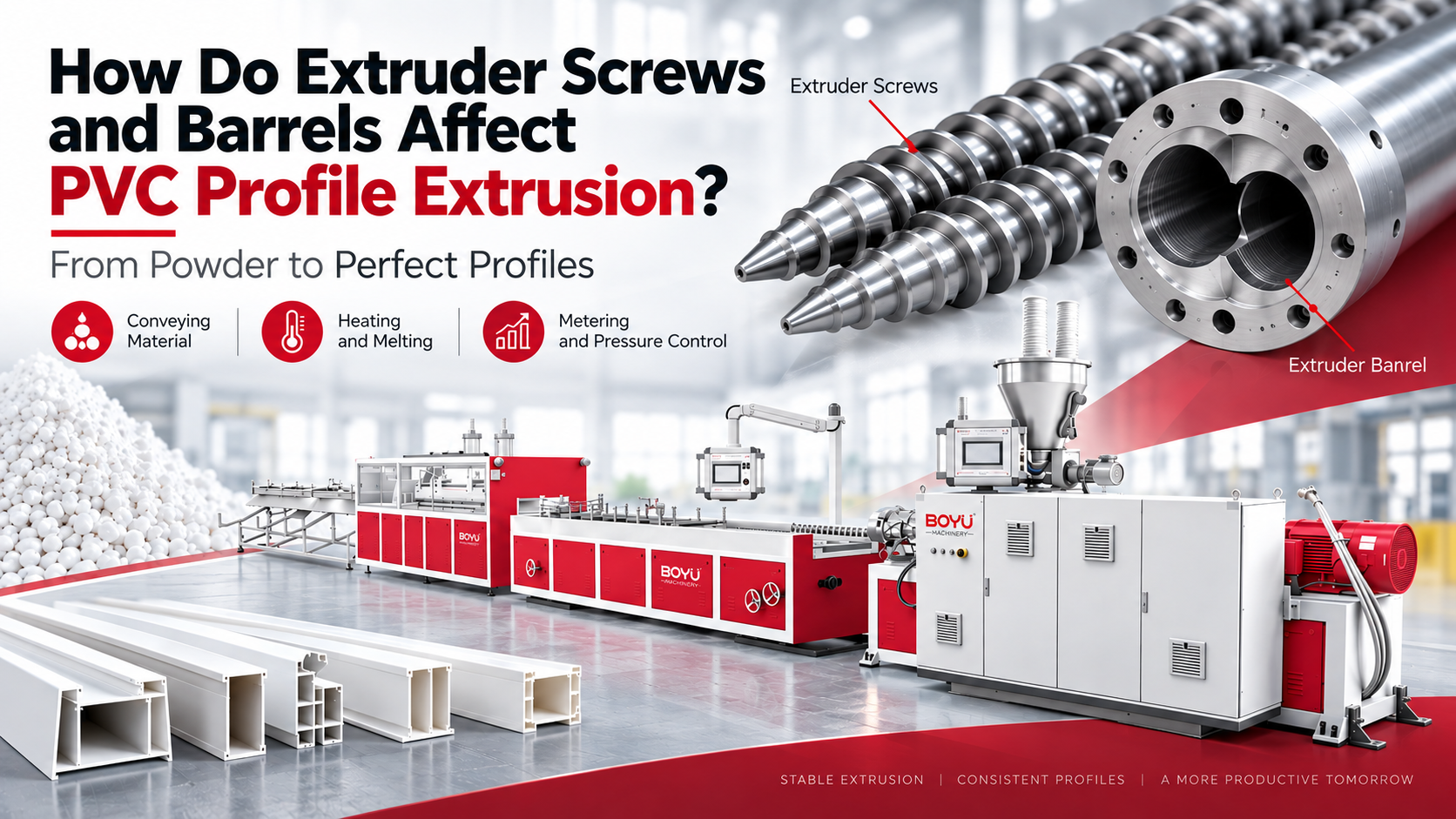
In PVC profile extrusion, the success of your final product hinges on one critical transformation: turning dry-blend powder into a flawless melt. Without the perfect balance of heat, compression, and shear inside the extruder screw and barrel, profiles suffer from dimensional drift and poor surface quality.
This article explores the core functions of extruder screws and barrels, detailing how they master this process to ensure long-term production stability.
The 3 Main Functions of Extruder Screws and Barrels
During PVC profile extrusion, extruder screws and barrels carry out three closely connected functions:
- Conveying the PVC compound. As the extruder screw rotates inside the barrel, it moves material forward from the feed zone toward the die, providing the continuous flow that extrusion depends on.
- Heating, compression and melting. Along the length of the extruder barrel, external heaters combined with the mechanical energy generated by the rotating screw progressively compress and heat the material, turning it from PVC powder into a homogeneous melt.
- Metering and pressure control.The internal geometry of the extruder screw and barrel keeps output consistent and maintains the pressure and temperature required for the specific PVC formulation being run. This is directly linked to the dimensional accuracy of the finished profile.
From Powder to Melt: How the Extruder Screw and Barrel Handle PVC
To achieve optimal PVC profile extrusion, conical twin-screw systems are widely preferred for processing rigid formulations. Here is what the extruder screw and barrel do at each stage as PVC compound moves through.
The Feed Zone: Drawing PVC Dry-Blend into the Extruder Barrel
The extrusion process initiates in the feed zone. Here, the extruder screw flights are deep, with wide channels engineered to capture and intake the low-density PVC dry-blend.
Once the powder drops from the hopper, the screw’s rotation creates positive displacement, drawing it into the barrel and conveying it steadily downstream toward the heating and compression stages.
Compression and Melting: Plasticizing Inside the Extruder Barrel
Transitioning from the feed zone, the material enters the compression phase. As it travels forward, the extruder screw’s root diameter gradually increases, decreasing the channel volume and compacting the PVC compound.
This mechanical compaction, combined with the shearing action of the screw, generates internal frictional heat. Simultaneously, the extruder barrel provides controlled external thermal energy through its heating zones.
Under this gradual combination of internal shear and external heating, the dry-blend slowly softens. By the end of this transition zone, the powder is completely plasticized into a thick, homogeneous melt.
The Metering Zone: The Extruder Screw Delivering a Stable Melt
Entering the final section of the extruder barrel — the metering zone — the plasticized melt undergoes final thermal and pressure homogenization.
At this stage, the extruder screw functions as a precise melt pump. Its primary role is no longer phase transition, but maintaining constant head pressure to extrude a steady, uniform volume of melt through the die.
The finished profile’s dimensional stability, weight per meter, and surface finish depend entirely on the consistency of this final melt delivery. Any fluctuation in pressure or flow rate here carries straight through to the end product.
Reliable Extrusion with the Boyu Machinery PVC Profile Production Line
Rigid PVC formulations rely on calcium carbonate (CaCO₃) fillers, which are highly abrasive. Over time, this wear increases the clearance between the extruder screw and barrel, destabilizing the melt delivery.
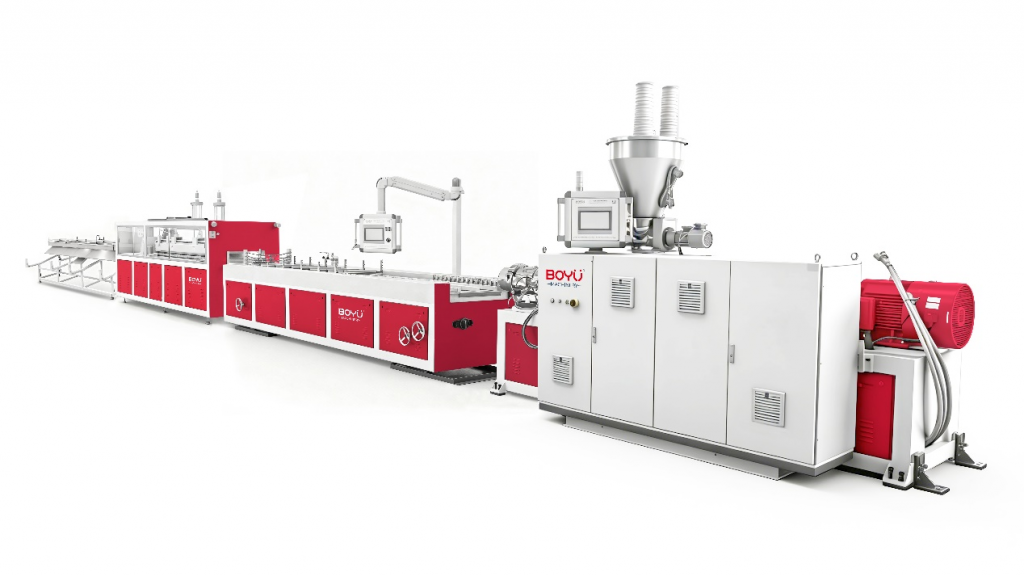
To ensure long-term stability against such challenges, the Boyu Machinery PVC Profile Production Line is built around a robust conical twin-screw extruder. Rather than relying on mismatched parts, Boyu Machinery designs the entire line — from the screw and barrel to the drive and control system — as a seamlessly integrated platform.
Equipped with premium components, including Omron or Siemens PLC touch-screens, Schneider low-voltage electronics, and NSK or SKF bearings, this unified approach ensures perfectly matched torque and precise temperature control. The result is a highly stable extrusion process that delivers consistent profile dimensions shift after shift.
Mastering Your PVC Profile Extrusion
Turning PVC powder into a flawless profile requires perfectly balancing shear, heat, and wear resistance within the extruder screw and barrel. To achieve this stability, the Boyu Machinery PVC Profile Production Line integrates a robust conical twin-screw extruder with premium Omron/Siemens and Schneider controls.
Are you struggling with inconsistent profile dimensions or rapid equipment wear? Contact Boyu Machinery today to upgrade your extrusion line and maximize your operational efficiency!