
PVC recycling is now closely connected with window profile manufacturing. According to the VinylPlus 2026 Progress Report, 765,972 tonnes of PVC waste were recycled within its European framework in 2025, up 5.7% from 2024. Window profiles accounted for 416,889 tonnes, making them the largest reported recycling stream.
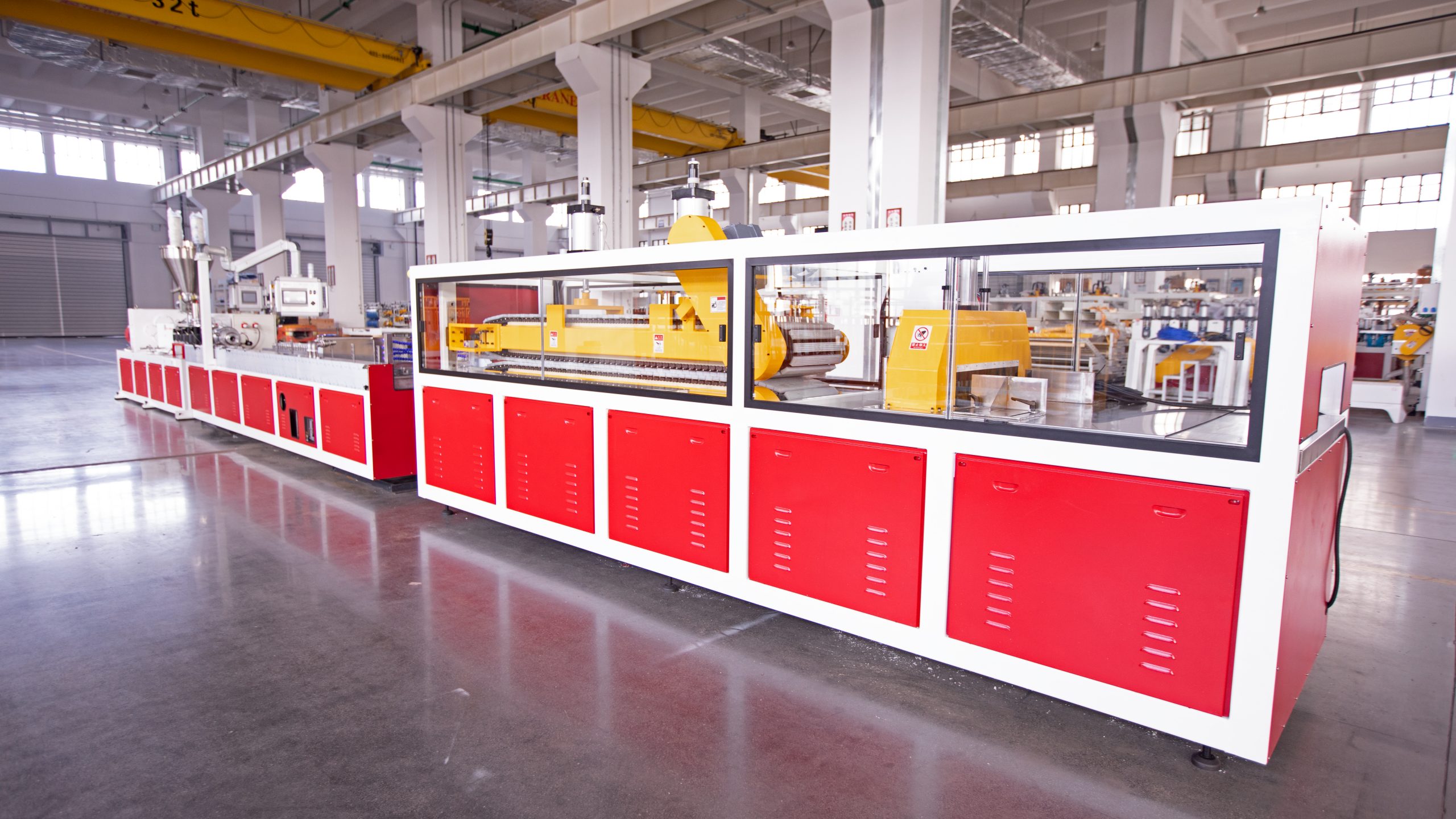
For PVC window profile manufacturers, this creates a practical question: when recycled PVC returns to production, what changes in PVC profile extrusion, and is the existing extrusion line ready to process it efficiently?
Why Recycled PVC Is Growing in Window Profiles
PVC window profiles have a long service life—typically around 50 years or more. With EPPA estimating that around 650 million PVC windows are currently in Europe’s existing building stock, an increasing number of older windows are now reaching the replacement stage. Better collection and sorting systems are also allowing used frames to return to profile production instead of being discarded.
European regulation provides a controlled route for certain building profiles containing recovered rigid PVC. Under Commission Regulation (EU) 2023/923, defined concentration limits, marking rules, and traceability requirements apply to recovered material containing legacy lead. This regulatory framework helps maintain controlled recycling routes while addressing material safety.
Carbon-reduction targets and raw-material security are further accelerating the shift. VinylPlus reports that 10.3 million tonnes of PVC have been recycled since 2000, avoiding an estimated 20.6 million tonnes of CO₂ emissions. For profile manufacturers, rPVC can reduce dependence on virgin resin and exposure to petrochemical price fluctuations.
What Changes in PVC Profile Extrusion When Using Recycled Material
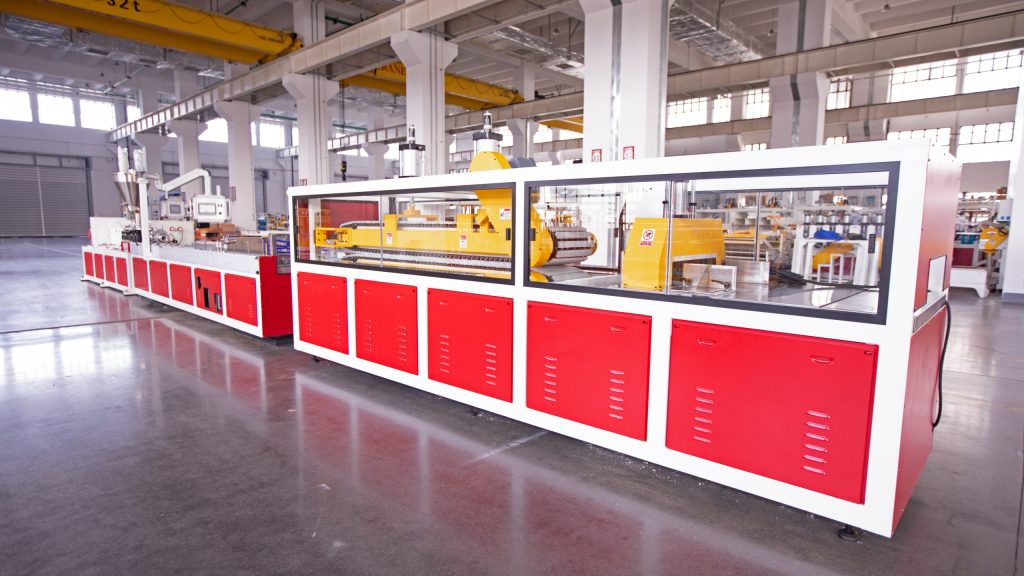
The basic extrusion process remains the same when recycled PVC is introduced. The main difference is that the PVC profile extrusion line must handle greater variation in material form, flow behavior, and thermal history while maintaining stable output and profile dimensions.
1. Extruder Load and Output Stability
Differences in particle size and bulk density can affect how consistently recycled PVC enters and fills the twin screws, causing fluctuations in torque, motor load, and output. To absorb these variations, the drive system, gearbox, screw design, and feeding unit must work together to maintain steady material conveying. Sufficient torque capacity and stable speed control help prevent frequent output surges.
2. Plasticization and Thermal Control
Because recycled PVC has already experienced at least one processing cycle, its thermal stability may vary between batches. The twin-screw extruder must therefore provide sufficient shear and mixing for uniform plasticization without generating excessive heat or extending material residence time. Accurate temperature-zone control, effective barrel cooling, stable screw speed, and reliable torque monitoring are important, while good screw-and-barrel condition helps maintain consistent plasticizing performance and output.
3. Die, Calibration, and Downstream Stability
Changes in material flow behavior can affect die swell, wall-thickness distribution, corner definition, shrinkage, and final profile dimensions. The die must therefore distribute the material evenly, while the vacuum calibration and cooling systems must stabilize the profile quickly after it exits the die. Synchronized haul-off and cutting equipment are also essential for maintaining consistent geometry and cutting length, especially with complex multi-chamber window profiles.
Is Your Extrusion Line Ready for Recycled PVC?
An existing line may be able to process a limited percentage of clean production regrind. When the recycled-content ratio increases or post-consumer material is introduced, the following machine systems should be evaluated carefully:
- Extruder drive and plasticizing unit: Can the motor, gearbox, screw, and barrel provide sufficient torque, stable conveying, and uniform plasticization without overheating the material?
- Temperature and process-control system:Can the machine independently control each temperature zone while reliably monitoring screw speed, motor load, and torque, and keeping the feeder synchronized with the extruder?
- Die and calibration system: Can the die distribute the material evenly, and can the vacuum calibration and cooling systems maintain consistent wall thickness, profile corners, and overall dimensions?
- Haul-off and cutting system:Can the haul-off remain synchronized with extrusion output while the cutting unit maintains accurate length without deforming the profile?
If several answers are uncertain, selected equipment upgrades may be necessary.
Build a Reliable PVC Profile Extrusion Line with Boyu Machinery
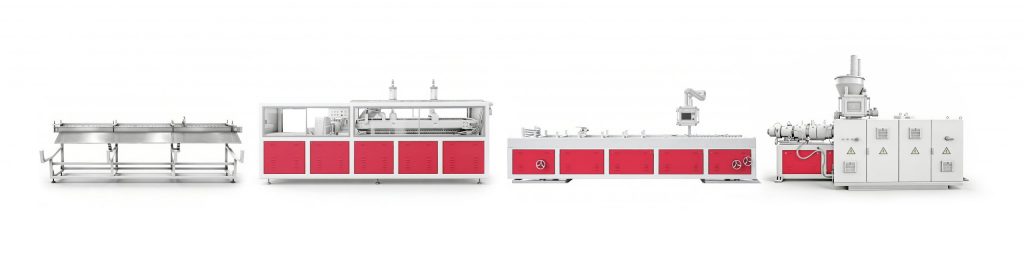
Stable plasticization, accurate forming, and consistent dimensions are essential in PVC window profile production. Boyu Machinery configures each PVC profile extrusion line according to the target product, profile drawing, material formulation, required output, and automation level.
This product-oriented approach enables Boyu Machinery to support window-profile projects. Beyond window-profile production, its broader equipment range also includes application-specific solutions such as a PVC door panel extrusion machine, PVC door frame extrusion machine, and PVC door profile extrusion machine.
To support stable production across these applications, Boyu Machinery coordinates the extruder, die, vacuum calibration, cooling, haul-off, and cutting equipment as a complete production system. The line uses PLC control with a touch-screen interface. PLC options include Omron or Siemens, while the touch screen may be a recognized Chinese brand or Siemens.
Together, flexible equipment configuration and coordinated process control make Boyu Machinery’s PVC profile extrusion line a practical choice for manufacturers seeking stable output, accurate dimensions, and consistent profile quality.
Ready for Stable PVC Profile Production with Recycled PVC?
Recycled PVC can reduce virgin-material use, but stable results depend on an extrusion line that can control feeding, plasticization, material flow, calibration, and downstream speed. Is your current line struggling with output fluctuations, unstable dimensions, or changing rPVC formulations? Share your profile drawings, material mix, target recycled-content ratio, and production concerns with Boyu Machinery. Our team can help you identify the right PVC profile extrusion line configuration for your project.
References
- https://www.recovinyl.com/post/european-pvc-recycling-reaches-765-972-tonnes-in-2025-demonstrating-resilience-amid-challenging-mar
- https://www.glassonweb.com/news/eppa-welcomes-lead-pb-pvc-reach-restriction-adopted-european-commission
- https://www.eppa-profiles.eu/sustainabilityofupvcwindows