
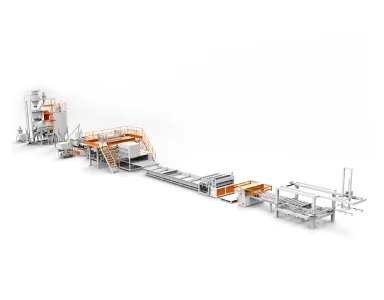
In the modern flooring industry, controlling the visual and tactile quality of LVT boards has become increasingly important. At Boyu, we focus on precision and reliability in every stage of production. Our LVT flooring extrusion line is designed to consistently deliver boards with the desired gloss and texture, meeting the varied requirements of our customers. By integrating high-quality components, precise temperature management, and advanced process control, we can achieve stable output without compromising the structural integrity of the boards. Understanding the interaction between raw materials, extrusion parameters, and cooling processes is essential for producing consistent LVT floors. As market demands grow for both aesthetic appeal and functional performance, we pay careful attention to how each production step influences the final board finish.
Factors Affecting Board Gloss and Texture
Several factors influence the surface appearance of LVT floors. The formulation, including PVC powder, calcium carbonate, DOTP, stabilizers, lubricants, and minor additives, determines how the board responds during extrusion. Our high-quality twin-screw extruder, certified by CE, ensures uniform mixing and precise melt consistency. The LVT flooring production line allows us to control screw speed, temperature zones, and die pressure accurately, which are critical for achieving uniform gloss and texture. We also monitor material moisture and particle size, as variations can lead to surface irregularities or uneven reflectivity. By carefully adjusting process parameters and monitoring each stage, we can balance surface smoothness with durability, slip resistance, and dimensional stability, ensuring boards consistently meet both aesthetic and practical requirements.
Optimizing the Extrusion Process
Through ongoing research and practical experience, we have developed methods to enhance the performance of our LVT flooring extrusion line. Our LVT Flooring Extrusion Line integrates precise temperature control, effective degassing, and stable pressure monitoring. These measures reduce defects such as surface roughness, warping, or inconsistent gloss. Additionally, our system supports customizable configurations based on raw material composition and production goals, allowing customers to produce boards with consistent finish and feel. By maintaining close monitoring during the extrusion process, we can respond to variations in material quality and machine conditions, ensuring reproducibility across production batches. This approach also contributes to energy efficiency and reduces downtime, which is increasingly valued in modern flooring manufacturing.
Conclusion: Ensuring High-Quality LVT Boards
In conclusion, controlling board gloss and texture in an LVT production environment requires attention to both materials and machinery. At Boyu, our LVT flooring production line and twin-screw extrusion technology allow us to deliver LVT floors with stable gloss, uniform texture, and high precision. By combining process knowledge, high-quality components, and customized solutions, we enable consistent performance and reliable outcomes for every batch. Our team continuously evaluates extrusion parameters, raw material selection, and line configuration to optimize both appearance and functionality. As the flooring industry continues to demand aesthetic appeal, durability, and efficiency, our systems provide the necessary control and flexibility to meet these expectations while maintaining energy-conscious and reproducible production.