
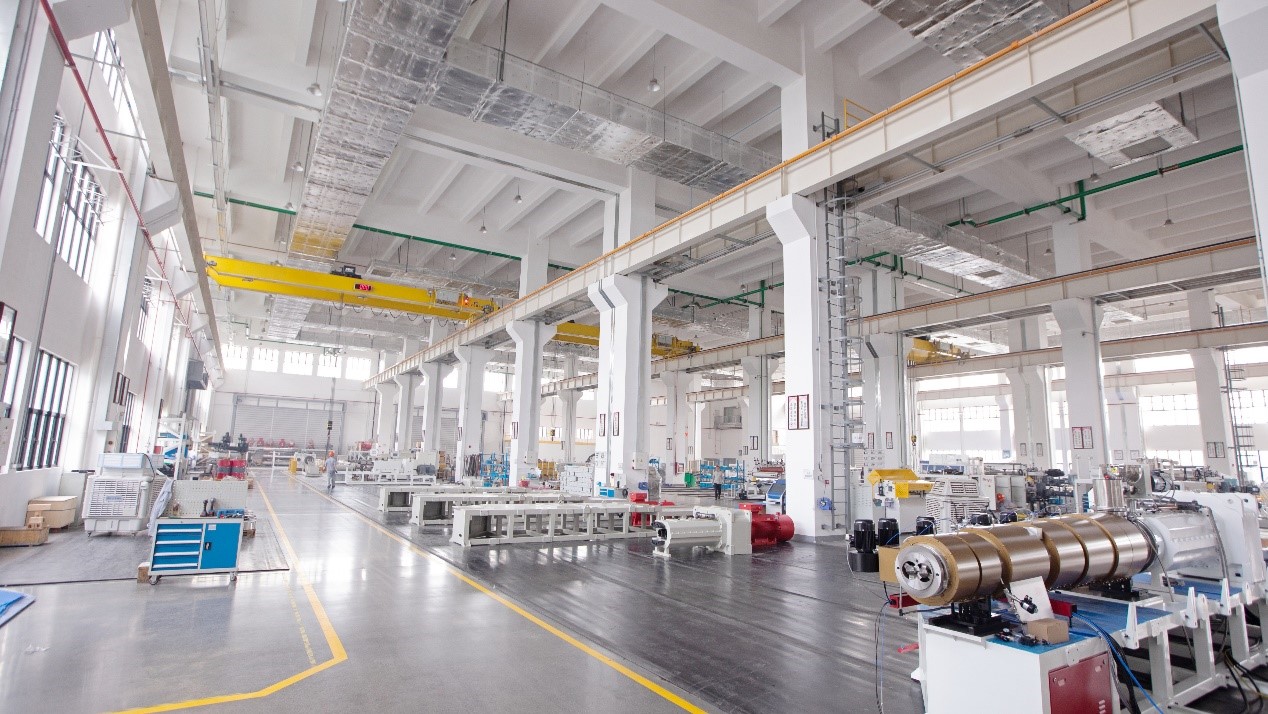
Choosing the right twin screw extruder is important for efficient and stable plastic extrusion. While both a conical twin screw extruder and a parallel twin screw extruder are widely used, they differ in screw structure, feeding performance, output capacity, and cost. This article compares their key differences to help buyers choose a suitable twin screw extruder machine.
What Is a Conical Twin Screw Extruder?
A conical twin screw extruder is a type of twin screw extruder with two tapered screws. The screw diameter gradually changes along the barrel, forming a conical screw structure.
Key Features
- Tapered twin-screw structure
- Different screw diameters between the feeding end and discharge end
- Compact screw arrangement
- Usually operates at relatively lower screw speeds
Benefits
- Provides stable torque during extrusion
- Helps maintain smooth material feeding
- Supports stable plasticizing and conveying
- Requires relatively lower initial investment
- Easier to operate and maintain in many production settings
Limitations
- Output capacity is generally limited compared with larger parallel designs
- Not always ideal for very high-throughput production
- Mixing and dispersion capacity may be weaker in some demanding formulations
What Is a Parallel Twin Screw Extruder?
A parallel twin screw extruder is a type of twin screw extruder with two screws arranged in parallel. The screws keep the same diameter along the barrel, forming a parallel screw structure.
Key Features
- Parallel twin-screw structure
- Same screw diameter from feeding end to discharge end
- Longer effective processing path
- Larger material-holding space inside the barrel
Benefits
- Supports higher production capacity
- Provides stronger mixing and dispersion performance
- Offers more process control flexibility
- Performs well in long production runs
- Better suited for automated high-output lines
Limitations
- Higher equipment investment
- Requires more accurate process control
- Operation and maintenance requirements are usually higher
- Needs well-matched downstream equipment to fully use its output potential
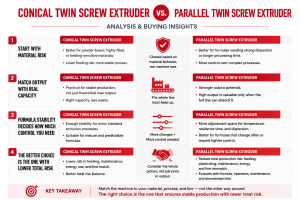
Conical Twin Screw Extruder vs Parallel Twin Screw Extruder: Key Comparison
When comparing a conical twin screw extruder with a parallel twin screw extruder, buyers should not only look at machine price or theoretical output. In real production, the most important factors are screw structure, feeding and material conveying, plasticizing and residence time, mixing ability, output capacity, energy use, maintenance, and full-line compatibility.
These factors are closely connected with real production issues such as unstable feeding, uneven plasticizing, limited output, high energy consumption, frequent maintenance, and poor matching between the extruder and downstream equipment. By comparing these points, buyers can better understand which twin screw extruder machine is more suitable for their material, formula, output target, and budget.
| Comparison Factor | Conical Twin Screw Extruder | Parallel Twin Screw Extruder |
| Screw structure | Tapered screw structure | Parallel same-diameter screw structure |
| Feeding and material conveying | Larger feeding-end space, stronger intake for powder and highly filled materials | More uniform screw channel volume, better for stable high-volume material conveying |
| Plasticizing and residence time | More concentrated compression, suitable for rigid materials requiring stable plasticizing | Longer processing path, with more room for residence time and temperature control |
| Mixing and dispersion | Suitable for standard formulations | Stronger mixing and dispersion for complex formulations |
| Output capacity | Medium to high output | Usually higher output |
| Energy use | Often economical for moderate output | More efficient when used for high-output production |
| Maintenance | Relatively simple | Requires more precise maintenance |
| Line compatibility | Suitable for standard extrusion lines | Requires stronger downstream equipment matching |
Conical Twin Screw Extruder vs Parallel Twin Screw Extruder: Analysis and Buying Insights
1. Start with material risk, not machine size
A common mistake is to compare machine size or motor power first. In practice, the material formula should come first. If the material is powder-based, highly filled, or sensitive to feeding stability, a conical twin screw extruder may reduce process risk. If the material needs stronger dispersion or longer processing time, a parallel twin screw extruder may be a better direction.
2. Match output with real production capacity
Higher output is valuable only when the full line can absorb it. A parallel twin screw extruder machine may have stronger capacity, but if cooling, forming, hauling, cutting, or stacking cannot keep up, the extra output becomes wasted investment. A conical machine can be more practical when the target is stable production instead of maximum theoretical output.
3. Formula stability decides how much control you need
If the formula is mature and the production process is already predictable, buyers may not need the most complex machine structure. A conical twin screw extruder can provide enough stability for many standard extrusion processes. If the formula changes often or requires tighter temperature, residence time, and dispersion control, a parallel twin screw extruder may provide more adjustment space.
4. The better choice is the one with lower total risk
The best twin screw extruder machine is not always the one with the highest output or the lowest price. It is the one that reduces total production risk: unstable feeding, poor plasticizing, difficult maintenance, energy waste, and line mismatch. Buyers should evaluate the machine together with formula, operator skill, maintenance ability, and downstream equipment.
Recommended reading: What Factors Should Be Considered Before Selecting an Extrusion Line?
Where Each Twin Screw Extruder Fits in Plastic Extrusion
In plastic extrusion, a conical twin screw extruder is often used when the process needs steady material conveying, consistent plasticizing, and relatively controlled investment. It is a practical choice for extrusion lines where production stability matters more than simply pursuing the highest possible output.
A parallel twin screw extruder, on the other hand, is often used when the process requires higher throughput, stronger mixing performance, and longer continuous operation. It is more suitable for extrusion lines where capacity, dispersion, and process flexibility are key considerations.
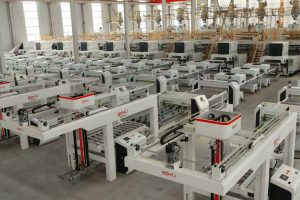
A Recommended Twin Screw Extruder Manufacturer: Boyu Machinery
For buyers looking for a reliable twin screw extruder manufacturer, Boyu Machinery is a strong choice for complete plastic extrusion line projects. Founded in 1998, Boyu Machinery has nearly 30 years of industry experience and a 60,000㎡ modern factory. With its experience in extrusion machinery and full-line project support, Boyu Machinery can help buyers build more efficient and better-matched plastic extrusion solutions.
Its advantages include:
- More Than an Extruder Supplier: Boyu Machinery provides complete extrusion line solutions, not only a standalone extruder. A typical line can include the extruder, T-die, calender, traction machine, cutting machine, cutting system, and automatic fipping & stacker system, helping buyers build a matched production process from material extrusion to final product handling.
- Built Around Real Production Needs: Boyu Machinery’s machines can be configured according to product structure, material formula, width, thickness, and output requirements, making the solution more closely aligned with actual factory production.
- Wide Coverage Across Plastic Extrusion Fields: With product lines covering flooring, board, sheet, profile, wood-plastic, and foaming-related applications, Boyu Machinery is suitable for buyers with different extrusion production requirements.
- Designed for Stable and Consistent Production: Boyu Machinery’s machines use practical control and component options, including PLC control with a touch-screen interface, Omron or Siemens PLC options, Schneider electrical components, and inverter options from Inovance, ABB, or Siemens. These configurations help support easier operation, process stability, and reliable extrusion performance.
Making the Right Choice
Choosing between a conical twin screw extruder and a parallel twin screw extruder depends on material behavior, output target, formula complexity, budget, and full-line matching. Before selecting a twin screw extruder machine, buyers should compare more than price or capacity. Not sure which structure fits your project? Contact us to discuss your material, product requirements, and production goals.