
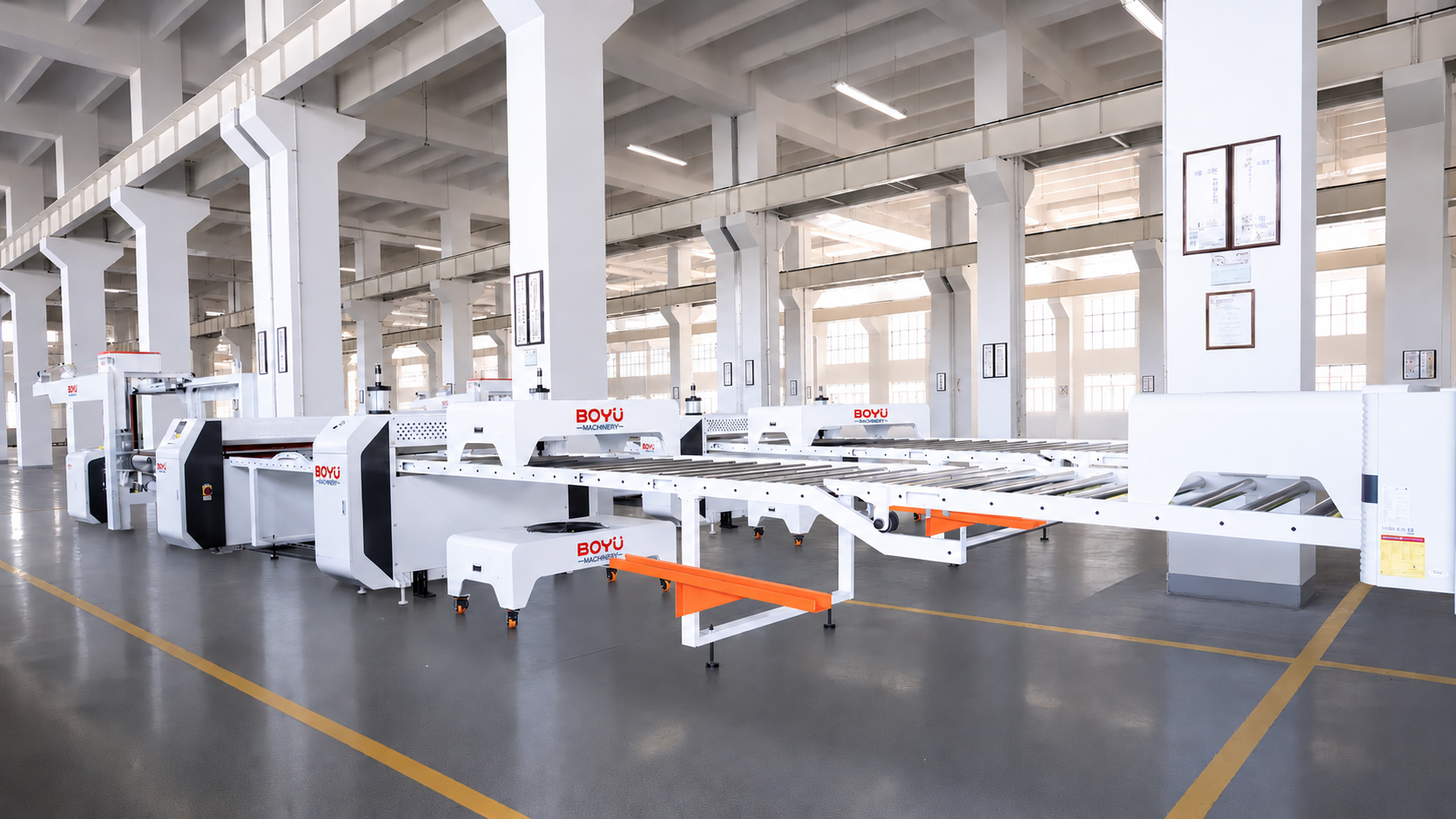
As industrial application requirements continue to diversify in terms of product structure, extrusion line systems have developed into multiple configurations to meet different production scenarios.
This article briefly introduces the main types of extrusion line systems and their applications, and focuses on how to choose the right extrusion line.
Types and Applications of Extrusion Lines
In practical industrial applications, different products have varying requirements for structural precision, material properties, and surface quality. Therefore, extrusion lines have gradually developed into various specialized configurations to adapt to different production scenarios and process requirements. The following are several widely used types of extrusion lines and their typical applications:
1. Sheet Extrusion Line
Sheet extrusion lines are mainly used for the continuous production of PVC sheets, foamed sheets, and various decorative panels.
This type of production line typically uses a multi-roll calendering and shaping system to precisely flatten and control the thickness of molten material, thereby achieving dimensional uniformity and stable surface quality of sheets. It is widely used in architectural decoration and industrial sheet material fields.
2. Pipe Extrusion Line
Pipe extrusion lines are suitable for the continuous production of various plastic pipes, such as PVC and HDPE.
Through the coordinated action of vacuum sizing systems and circulating cooling systems, the outer diameter accuracy, roundness, and wall thickness uniformity of pipes can be effectively controlled, enabling products to meet the requirements of municipal engineering, water supply and drainage systems, and industrial pipeline applications.
3. Profile Extrusion Line
Profile extrusion lines are mainly used for the production of door and window profiles, decorative profiles, and various complex cross-section structural products.
Through the precise coordination of vacuum calibration tables, multi-point cooling systems, and haul-off devices, stable forming of cross-sectional structures and dimensional accuracy control are achieved. These lines are suitable for applications with high requirements for appearance and structural consistency.
4. WPC / Composite Extrusion Line
This type of production line is optimized for high-filler or composite material systems and is suitable for the production of wood-plastic composites and other functional composite materials.
It is usually equipped with high-torque extruders and reinforced plasticizing systems to improve material dispersion and plasticization capability, ensuring stable continuous forming performance under high-viscosity and high-filler formulations. Therefore, this type of equipment is suitable for large-scale production of architectural decorative profiles, outdoor structural components, landscape engineering materials, and various high-filler composite material products.
5. Flooring Extrusion Line
Flooring extrusion lines are mainly used for the continuous production of SPC, WPC, and PVC flooring products.
Through multi-layer co-extrusion and composite forming processes, the base layer, decorative layer, and wear-resistant layer are integrated into a single structure, ensuring consistency in dimensional stability, structural strength, and surface appearance of flooring products.
The following table summarizes the main types of extrusion lines along with their applications and process characteristics:
| Production Line Type | Main Products | Core Process Features |
| Sheet Extrusion Line | PVC sheets, foamed sheets, decorative panels | Multi-roll calendering, thickness control |
| Pipe Extrusion Line | PVC/HDPE pipes | Vacuum sizing, cooling calibration |
| Profile Extrusion Line | Door and window profiles, decorative profiles | Vacuum calibration, multi-point cooling |
| WPC / Composite Extrusion Line | WPC and high-filler composite materials | Enhanced plasticization, high-torque extrusion |
| Flooring Extrusion Line | SPC/WPC/PVC flooring | Multi-layer co-extrusion, structural compounding |
Further reading: Flooring Trends 2026: 5 Major Shifts in Eco-Friendly Manufacturing
How to Choose the Right Extrusion Line for Your Production?
Production Capacity and Process Takt Time
When selecting an extrusion line, production capacity matching and process cycle consistency should first be considered to determine whether the equipment can stably meet the target output under actual operating conditions, rather than relying solely on theoretical rated capacity.
- Ideal cycle time (Tc) is used to measure the theoretical production cycle under 100% efficiency conditions, which is determined by the slowest station processing time and material transfer time.
- Actual production time (Tp) needs to comprehensively consider equipment downtime factors, including mechanical failures, process adjustments, and maintenance impacts, where downtime frequency (F) and single downtime duration (Td) are key variables.
In practical selection, attention should be focused on comparing the difference between the theoretical capacity corresponding to Tc and the actual achievable capacity corresponding to Tp, in order to determine whether the equipment has “continuous production capability”.
In actual applications, extrusion capacity is also affected by the following key parameters:
- Screw speed
- Screw diameter
- Length-to-diameter ratio (L/D ratio)
These parameters jointly determine the actual output capability and stable operating upper limit of the equipment.
Therefore, in the selection process, emphasis should be placed on whether capacity margin design can cover fluctuations in actual production, rather than simply meeting theoretical rated capacity.
Material System and Processing Compatibility
Secondly, selection should start from the material system and processing compatibility to determine whether the equipment can stably adapt to the process window of the target material, rather than only considering “whether it can be processed”.
For different material types, attention should be focused on differences in their process requirements for extrusion systems:
- PVC and other thermally sensitive materials usually require precise temperature control systems and twin-screw structures to ensure melt uniformity and processing stability.
- PE and PP, which are thermally stable materials, can be processed using single-screw extrusion systems for stable production.
- For filled or modified formulation systems, screw structure optimization and torque configuration are required to improve mixing and dispersion capability.
In addition, the screw compression ratio (CR) must be matched with material characteristics to ensure plasticization quality and melt uniformity.
Line Synchronization and System Coordination
In addition, the synchronization and system coordination capability of the entire production line should be evaluated to ensure consistency among all process units under dynamic operating conditions.
A standard extrusion line typically consists of a feeding system, extruder, die, cooling and sizing system, haul-off unit, and cutting/winding unit. All units must achieve dynamic matching.
Among them, the matching relationship between haul-off speed and extrusion output speed is particularly critical, directly affecting final product dimensional accuracy (such as pipe outer diameter or profile cross-sectional stability). At the same time, for process stability, attention should also be paid to phenomena such as melt surging, which can be controlled through screen pack configuration and screw structure optimization.
Factory Layout and Engineering Constraints
In addition, an evaluation should be made from the perspective of plant layout and engineering condition compatibility to ensure that the equipment can be properly installed and stably operated in the actual production environment.
An extrusion line usually consists of multiple continuous process sections, and its total length, functional zoning, and auxiliary system configuration (such as cooling, haul-off, and cutting units) will directly affect factory space requirements. Therefore, in the selection stage, it is necessary to confirm whether the production line matches the factory’s effective length, ceiling height, and equipment layout paths.
At the same time, different process structures have different spatial requirements. For example, cooling section length and sizing system configuration may affect overall layout design. Therefore, spatial conditions should be fully evaluated before selection.
In addition, maintenance and operational convenience should also be considered, including disassembly space for key components, reserved maintenance access channels, and accessibility of functional units. These factors will directly affect long-term operational efficiency and maintenance costs.
Lifecycle Performance and Scalability
In extrusion line selection, lifecycle performance and long-term expansion capability should also be evaluated to avoid focusing only on short-term production requirements.
For high-wear or corrosive material applications, screw and barrel structures with nitriding treatment, bimetallic liners, or special coatings should be preferred to improve service life and stability.
In process scaling, maintaining a consistent diameter ratio (Do/Di) design helps achieve stable transfer of process parameters between laboratory and industrial production.
In addition, energy consumption level (kWh/kg) is also an important evaluation indicator, which can be reduced through high-efficiency motors and optimized screw design. At the same time, systems with predictive maintenance capabilities (such as vibration monitoring and gearbox oil condition analysis) can effectively reduce the risk of unplanned downtime.
Your Partner in High-Performance Extrusion Solutions—Boyu Machinery
We, Boyu Machinery, were established in 1998 and are a leading innovator in the field of plastic extrusion equipment.
We have obtained over 120 technical patents and serve customers in 66 countries worldwide. We are committed to providing diversified and efficient extrusion lines covering flooring, profiles, foamed sheets, panels, and various functional composite materials.
We integrate advanced PLC automation control with precision extrusion technology, achieving a balance of high productivity, low energy consumption, and excellent processing accuracy.
We always place customers at the center of our development, offering professional support ranging from customized solution design to full lifecycle equipment services.
Choosing Boyu Machinery means partnering with a dedicated extrusion technology team to drive manufacturing systems toward greater intelligence and sustainability.
Conclusion
In conclusion, selecting an extrusion line requires careful consideration of production capacity, material compatibility, system synchronization, layout conditions, and lifecycle performance. Boyu Machinery provides advanced, efficient, and customized extrusion solutions to meet diverse industrial needs.
Contact us today to find the right solution for your production.
References
- https://en.wikipedia.org/wiki/Die_forming_(plastics)
- https://www.sharcpm.com/news/factors-to-consider-for-extrusion-line-for-plastic-processing/
- https://www.scribd.com/document/437851595/Screw-Design