
What separates the flooring manufacturers who will thrive in the next few years from those who won’t? Increasingly, the answer comes down to sustainability. As global regulations tighten and demand for eco-friendly floors accelerates, adapting is no longer optional — it is the price of staying in the game.
The flooring trends 2026 brings are already reshaping how the world’s best manufacturers operate.
What’s driving the shift toward eco-friendly flooring?
Four forces are converging, and together, they’re accelerating the industry’s transformation faster than most manufacturers anticipated.
- Stricter carbon and plastic regulations across the EU, North America, and Asia-Pacific markets
- Rising end-user demand for certified sustainable flooring materials with verifiable lifecycle data
- Volatile raw material costs are pushing companies toward recyclable and high-efficiency material systems
- Long-term cost reduction pressure driving process and formulation optimization at scale
Flooring trends 2026: what’s changing, and why it matters
Trend 1: Eco-Friendly Materials Become Standard Configuration
Recycled PVC content, low-VOC additive systems, and renewable filler materials are no longer niche specifications; they are rapidly becoming the industry baseline. Major importing markets now treat environmental certification as a procurement prerequisite, not a differentiator. Manufacturers still relying on conventional formulations risk being filtered out of key supply chains well before this decade ends.
Trend 2: Production Lines Shift Toward Energy Efficiency
Energy consumption has moved from a background cost to a front-line engineering priority. Next-generation extrusion and calendering equipment is being redesigned to reduce per-unit energy use through optimized screw geometry, smarter thermal management systems, and leaner drive configurations. For manufacturers operating under carbon quotas or facing rising electricity costs, upgrading to energy-efficient production lines is increasingly a direct bottom-line decision.
Trend 3: Smart Manufacturing and Digital Control Go Mainstream
Real-time process monitoring, automatic parameter adjustment, and production traceability are increasingly being implemented beyond large-scale operations. Mid-sized flooring producers are integrating digital control systems to cut scrap rates, reduce human error, and sustain consistent quality across longer continuous production runs. In 2026, production stability and data visibility carry as much commercial weight as raw output capacity.
Trend 4: Multi-Layer Composite Structures Continue to Evolve
SPC and LVT remain the dominant categories in global flooring exports, but their internal architecture is becoming more refined. Thinner functional layers, tighter dimensional tolerances, and more precise material distribution are being engineered to better balance performance against resource efficiency. This evolution places significantly higher demands on the accuracy and repeatability of the extrusion lines used to produce them.
Trend 5: High-Stability Continuous Production Becomes the Industry Standard
The industry is moving toward highly stable continuous production with reduced manual intervention and tighter process control — and the shift is accelerating. This model directly improves yield, reduces unplanned downtime, and lowers per-unit costs across the board. It is also essential for manufacturers scaling up across emerging product categories, where tight process control is critical to sustaining quality at volume.
How Boyu Machinery Supports the Transition
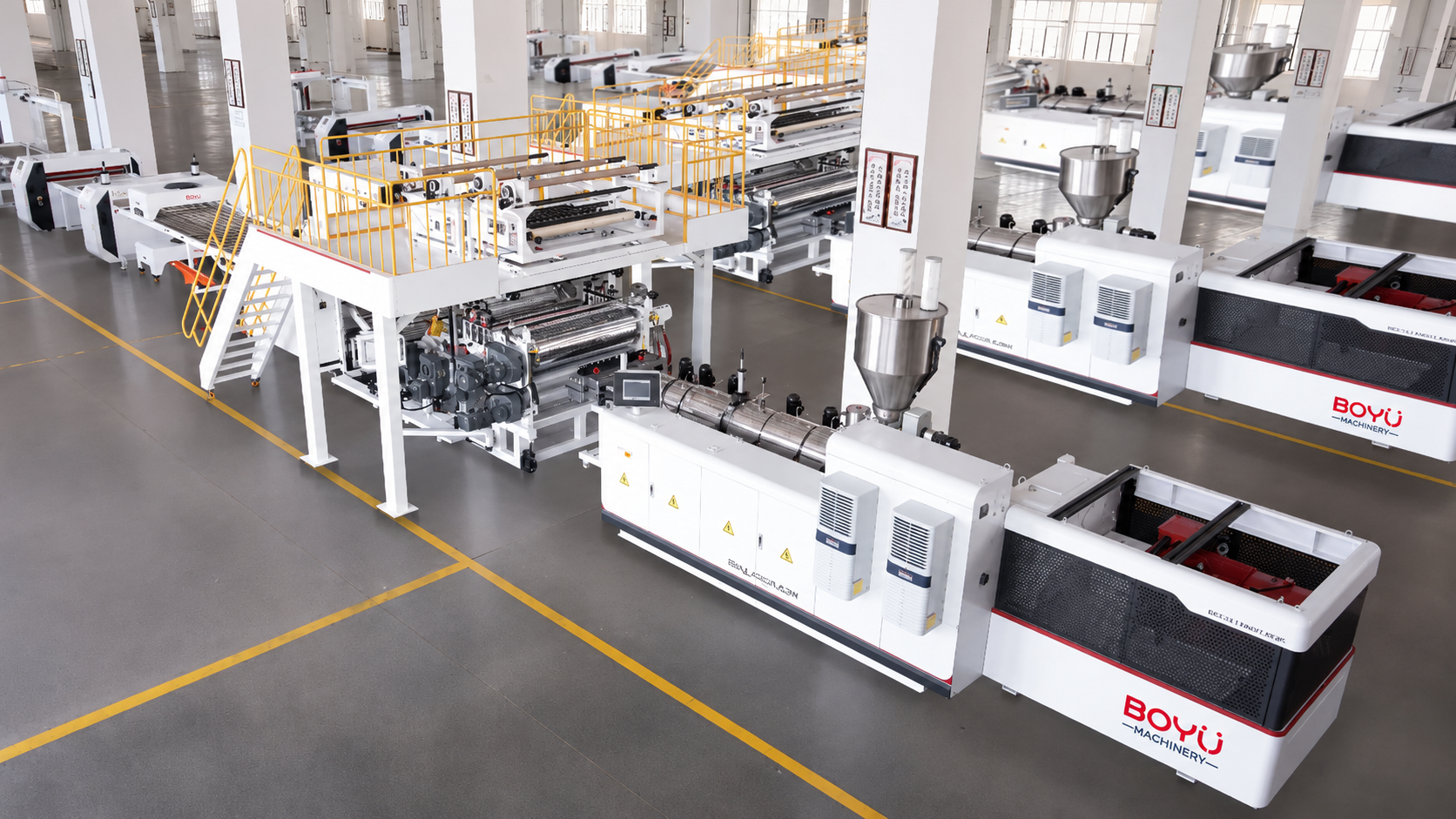
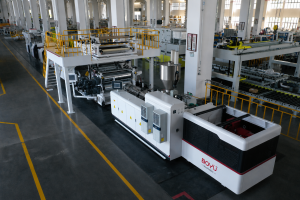
Keeping pace with these flooring trends 2026 demands more than updated formulations — it requires production equipment engineered specifically for what comes next. Boyu Machinery, founded in 1998, has spent nearly 30 years developing high-precision extrusion solutions for the global flooring industry.
With over 120 patents and a 60,000-square-meter manufacturing facility operating under an ISO 9001-certified quality management system, Boyu Machinery delivers a complete product portfolio built around the challenges manufacturers face today:
- SPC Flooring Extrusion Line: Engineered for multi-layer precision and high-stability continuous output, ideal for the growing complexity of stone-plastic composite structures.
- LVT Flooring Extrusion Line: Designed for tight dimensional control and consistent surface quality across extended production runs.
- WPC Flooring Extrusion Line: Delivering stable composite structures, high-efficiency continuous output, and flexible multi-width customization — well suited for manufacturers with demanding capacity and consistency requirements.
- Energy-efficient design across all lines: Intelligent control integration, low energy consumption by design, and stable,reliable performance are built into every Boyu Machinery production line — not added as afterthoughts.
- → Explore Boyu Machinery’s flooring extrusion solutions.
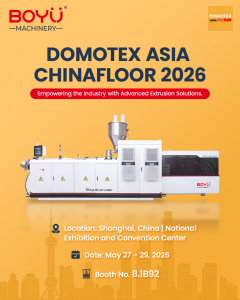
Meet Boyu Machinery at DOMOTEX ASIA CHINAFLOOR 2026
DOMOTEX ASIA CHINAFLOOR is a leading platform for the carpet and flooring industry, bringing together professionals from across the globe in Shanghai for its 28th edition. Every year, the show welcomes more than 1,500 companies and brands across an exhibiting space of over 210,000 sqm, making it the largest global meeting point for the flooring industry in the Asia-Pacific region.
Come and see Boyu Machinery’s latest flooring extrusion solutions in person:
- Location:National Exhibition and Convention Center (NECC), Shanghai, China
- Date:May 27 – 29, 2026
- Booth No.:1B92
Conclusion
The five flooring trends 2026 presents — greener materials, energy-efficient production, smart manufacturing, refined composite structures, and continuous stable output — collectively point toward a more sustainable and precise manufacturing future. Boyu Machinery’s full range of extrusion lines, backed by nearly 30 years of expertise and 120+ patents, is purpose-built to help manufacturers meet these demands head-on.
Contact us today to find the right production line for your operation.