
In modern extrusion manufacturing processes, maintaining consistent output quality is essential for ensuring dimensional accuracy and surface performance. However, achieving stable extrusion process stability across the entire production cycle remains a common challenge for many manufacturers. This article explores five practical techniques to improve stability in an extrusion line, helping achieve more reliable and high-quality extrusion results.
Why Is Extrusion Process Stability So Important?
In continuous extrusion production processes, the material undergoes a dynamic transition from melting, plastification, and forming to cooling. Even minor fluctuations can be amplified along the product length, ultimately affecting dimensional accuracy, surface quality, and structural consistency. Therefore, extrusion process stability is fundamentally the result of coordinated operation across the entire extrusion line, rather than the performance of a single machine.
In actual production, instability is typically manifested as:
- Output fluctuation
- Wall thickness / profile dimensional deviation
- Surface waviness, draw marks,or roughness variation
- Cyclic defects caused by unstable melt pressure
To achieve stable extrusion production, the key lies in systematic control of each core process stage. The following sections explain five key control points for improving extrusion process stability in practice.
Top 5 Tips to Improve Extrusion Process Stability
Tip 1: Stable Melt Plastification and Temperature Control
During extrusion start-up and stable operation, the state of melt formation is primarily determined by the temperature distribution inside the barrel and shear conditions. Therefore, control focus should be placed on the balance and repeatability of the plastification process.
- Segmented temperature profile setting: The extruder barrel is typically divided into the feeding zone, melting zone, and melt conveying zone. In practice, temperature settings should be adjusted according to material melting characteristics, and each zone should be fine-tuned after a 1–2 hour stabilization period to ensure a stable melt state and avoid local overheating or insufficient plastification.
- Screw speed stability control: Screw speed directly affects residence time. It must remain stable (recommended fluctuation within ±1%). Frequent manual adjustment should be avoided, and a fixed process speed curve should be set via a frequency converter to reduce melt flow pulsation.
- Regular calibration of heating bands and thermocouples: It is recommended to perform periodic inspections (e.g., monthly or after material change). Deviation should be corrected by comparing the set temperature withthe actual barrel surface temperature to prevent local temperature control distortion.
- Melt pressure feedback control: Melt pressure is an important indicator of plastification quality. A stable pressure monitoring point should be established at the die inlet. When periodic fluctuations occur, priority should be given to adjusting screw back pressure or feeding rate rather than directly adjusting temperature, to ensure stable control logic.
Only after this foundation is stabilized can downstream die flow and forming processes maintain consistent input conditions, thereby reducing system fluctuations.
Tip 2: Stable Feeding System and Conveying Consistency
In continuous production, fluctuations at the feeding stage are directly reflected in downstream pressure and output variations. Therefore, continuous feeding stability must be ensured.
- Stable feeding system: A gravimetric feeding system should be preferred. In actual operation, a target feeding curve (instead of manual adjustment) should be used to maintain constant input per unit time and reduce fluctuations at the source.
- Prevent unstable feeding: The hopper area should be equipped with a bridge-breaking device. Before start-up, material dryness and particle size distribution should be checked. If bridging occurs, the hopper level should be reduced first, and vibration or de-bridging frequency should be increased rather than increasing screw load.
- Control of regrind ratio stability: Regrind material must be pre-mixed with virgin material before entering the main hopper, and the ratio should remain constant during production to avoid melt flow variation caused by frequent formulation changes.
- Regular maintenance of the feeding system: The hopper and screw feeding section should be cleaned regularly to prevent material accumulation or bridging that affects continuous feeding stability.
Therefore, feeding control is not about “ensuring material supply”, but about ensuring consistent input per unit time.
Tip 3: Die Channel Design and Melt Distribution Balance
During melt entry into the forming stage, flow resistance and distribution directly determine velocity consistency across the cross-section. Therefore, flow balance control of the die system is required.
- Die channel pressure balance: Before start-up, flow pre-pressure testing (or trial material observation) should be conducted. Distribution cores or flow resistance structures should be adjusted to keep pressure differences within a controllable range and avoid local overfeeding or material shortage.
- Die lip adjustment: In production, a “micro-adjustment + stabilization waiting”method should be used. After each adjustment, sufficient stabilization time must be allowed to avoid misjudgment caused by unstable melt flow.
- Temperature uniformity control of die: Die temperature should be monitored by zones. When local deviation occurs, heating circuits should be adjusted instead of changing the overall setpoint to maintain viscosity consistency.
- Production feedback correction: During stable operation, cross-sectional measurements of samples should be used to adjust flow balance or local die gap, achieving dynamic correction and long-term stable output.
When flow channels and distribution reach balance, a uniform cross-sectional foundation is established for the downstream cooling stage.
Tip 4: Stable Cooling and Sizing Control
During the transition from molten to solid state, slight variations in cooling and sizing conditions directly affect final dimensional results. Therefore, cooling must be precisely controlled.
- Vacuum sizing stability: The vacuum level should be gradually established during start-up (multi-stage vacuum application) to avoid deformation caused by sudden full vacuum. During production, vacuum fluctuations must be continuously monitored and kept within a stable range.
- Constant cooling water temperature: A constant temperature control system should be used. Frequent start-stop of cooling circulation should be avoided. When ambient temperature changes significantly, flow rate adjustment should be used instead of temperature setpoint changes to maintain a stable cooling rate.
- Matching haul-off and cooling: Haul-off speed must be calibrated based on actual cooling length. During speed adjustment, the material solidification state must be observed to avoid deformation caused by “pulling before full solidification”.
- Cooling channel maintenance control: Cooling channels and spray systems should be cleaned regularly to ensure uniform water distribution and avoid dimensional deviation caused by uneven cooling.
The core of this stage is ensuring that the material is fully stabilized before being subjected to mechanical force.
Tip 5: Closed-Loop Control and Line Speed Synchronization
In the entire production line, all equipment must operate in synchronized rhythm. Any speed mismatch will lead to system fluctuations, therefore closed-loop control is required.
- Extrusion and haul-off synchronization: The target draw-down ratio (DDR) should be set first, and then screw speed and haul-off speed parameters should be derived accordingly to avoid system imbalance caused by unilateral adjustments.
- Closed-loop control system:
The meter weight control system should automatically adjust screw speed or haul-off speed based on real-time deviation instead of manual intervention
Online thickness measurement systems should set alarm thresholds and feed data back to the control system, forming a “detection–correction–stabilization” loop
- Process adjustment rhythm control: All speed or parameter adjustments must follow a “single-variable adjustment + stabilization observation period (3–5 minutes)”principle to avoid system instability caused by multiple simultaneous changes
When a unified closed-loop system is established across the entire line, the extrusion process achieves true repeatability and long-term stability.
Boyu Machinery: Extrusion Process Stability Solutions
Through long-term industry application and technological development, we have accumulated systematic engineering experience in extrusion process stability control, enabling our equipment to be suitable for both single applications and complex extrusion production requirements.
In terms of process stability, our core strengths are reflected in the following aspects:
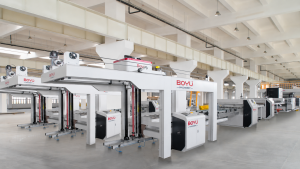
- Intelligent PLC closed-loop control system: Integrated with Siemens and Omron industrial-grade control components, enabling real-time monitoring and automatic adjustment of temperature, pressure, and screw speed, reducing fluctuations at the system level and improving stability.
- Efficient plastification performance: Relying on our independently developed twin-screw extrusion technology, materials achieve uniform shear and mixing inside the barrel, improving melt consistency.
- System-level quality standards: Our equipment complies with CE and CSA international standards, with emphasis on the long-term stable operation of key components to ensure continuous production reliability.
Based on long-term engineering practice and equipment optimization experience, we have developed a mature extrusion process stability control system, providing reliable equipment and process support for manufacturers of different scales.
Conclusion
In summary, extrusion process stability relies on systematic control of feeding, plastification, die design, cooling, and closed-loop synchronization. With advanced extrusion line technology and engineering experience, Boyu Machinery provides reliable solutions to enhance production stability and quality.
For more information on our extrusion systems and customized solutions, please contact us.
References
- https://gaugeadvisor.com/2025/05/04/when-should-you-install-a-thickness-measurement-system-on-a-film-or-sheet-extrusion-line/
- https://www.asaclean.com/blog/addressing-common-issues-in-twin-screw-extrusion-troubleshooting-guide