
Quick Answer
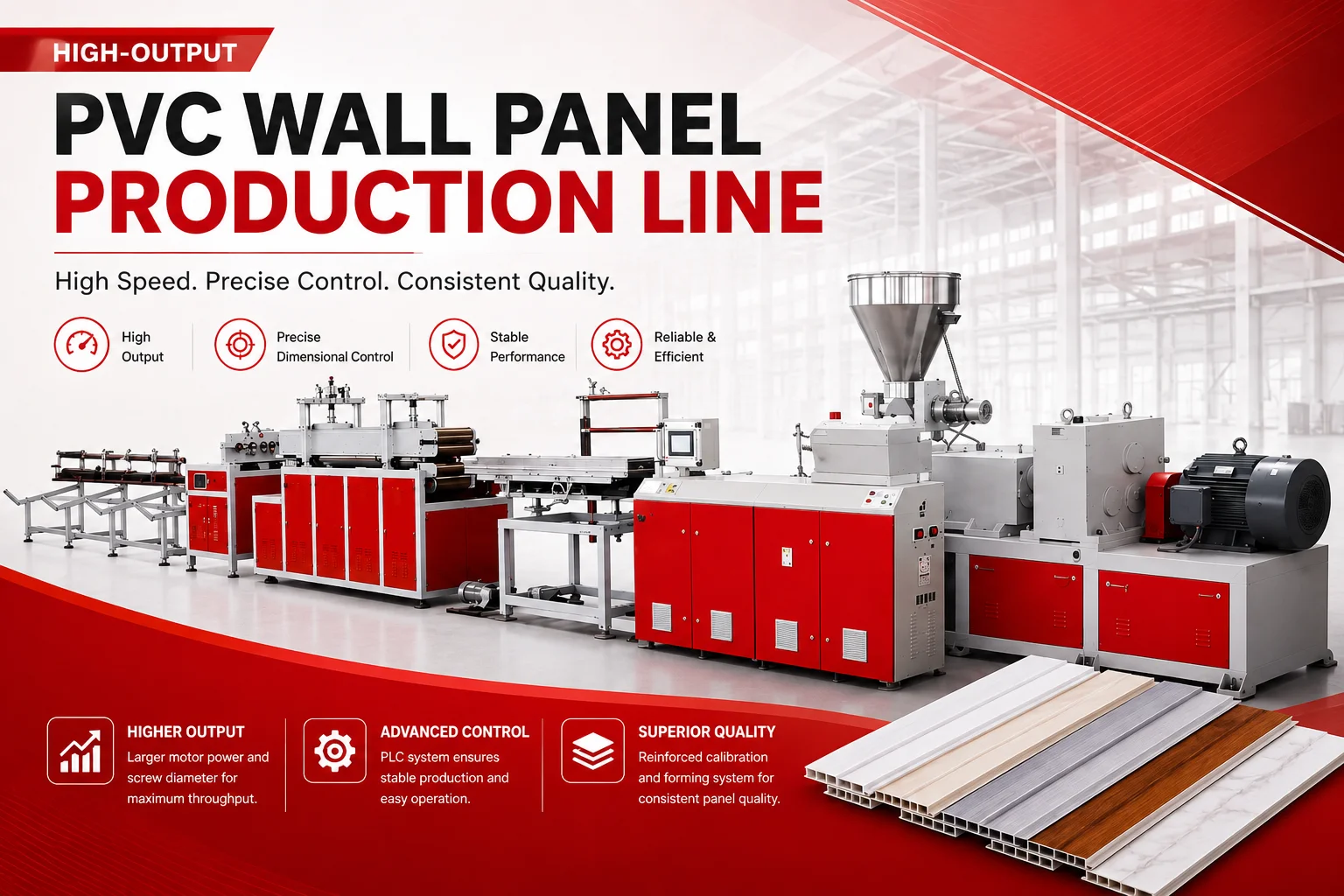
A high-output PVC wall panel production line is an extrusion system designed to manufacture rigid PVC wall panels at high production speeds while maintaining precise dimensional control, stable plasticizing, and consistent surface quality. Modern high-output systems, such as those developed by experienced manufacturers like Boyu Machinery, integrate advanced extrusion technology to reliably produce panels at scale.
What Is a PVC Wall Panel Production Line?
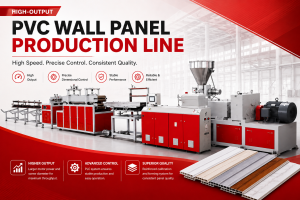
A PVC wall panel production line is a plastic extrusion system designed to manufacture PVC decorative wall panels. It processes PVC compound materials through extrusion, T-die forming, and calendering to produce panels with controlled thickness, stable dimensions, and high-quality surface finishes.
The basic working process includes the following steps:
- Feeding the PVC-calcium carbonate compound
- Melting and plasticizing the material
- Extruding through a T-die
- Forming and calibrating the panel profile
- Haul-off of the formed panel
- Cutting the panel to required length
- Automatic flipping and stacking
During production, multiple parameters must be carefully controlled, including:
- Melt temperature
- Extrusion output
- Panel thickness
- Panel width
- Haul-off speed
Main Features of High-Output PVC Wall Panel Production Lines
Higher Motor Power and Torque
What sets a high-output line apart starts with the extruder’s motor: greater power and torque allow the screw to push more material through the barrel per minute without losing pressure stability. Combined with a wider feeding throat and optimized screw compression ratio, this lets the line process a larger volume of PVC-calcium carbonate compound per hour than a standard setup.
Larger Screw Diameter for Higher Throughput
Screw diameter is a direct driver of output: a larger diameter increases the volume of material each screw rotation can convey, which is why high-output lines typically move from smaller extruder models up to larger ones as required capacity increases. A larger screw also improves mixing efficiency, helping maintain uniform plasticizing of high-filler PVC-calcium carbonate compounds even at faster speeds.
Reinforced Calibration System for Higher-Speed Dimensional Control
Increasing production speed only delivers value if the panel still maintains accurate dimensions and consistent quality. High-output lines use reinforced forming and calibration systems — including precisely designed calibration tooling and optimized cooling control — to stabilize the panel profile at higher production speeds while reducing dimensional variation. This helps maintain product consistency and minimize material waste during continuous production.
Faster-Response PLC Control
At higher production speeds, stable process control becomes increasingly important. High-output lines use advanced PLC-based control systems to monitor and adjust key production parameters, including temperature, extrusion speed, and operating status. This allows operators to detect process deviations earlier and maintain stable production quality during continuous operation.
Higher-Capacity Feeding and Mixing Systems
Extrusion speed is limited by how quickly raw material can be fed and pre-mixed. High-output lines are paired with larger-capacity mixing and feeding equipment, ensuring the extruder is supplied with a steady, uninterrupted stream of PVC-calcium carbonate compound. Without this upstream capacity, even a powerful extruder would run below its rated output due to material starvation.
Reinforced Haul-Off and Cutting for Continuous Operation
As line speed increases, the haul-off and cutting units must keep pace without introducing vibration or misalignment that could affect panel straightness. High-output lines use reinforced traction mechanisms and synchronized cutting systems to maintain accurate, repeatable cuts at higher speeds, supporting continuous operation over extended production runs.
Typical Output and Machine Configurations
Taking Boyu Machinery’s PVC profile extrusion line as an example, different machine configurations are available to meet different PVC wall panel manufacturing requirements.
| Extruder Model | Main Motor Power | Typical Output |
| SJSZ-48/51 | 15 kW | 120 kg/h |
| SJSZ-55 | 22 kW | 150 kg/h |
| SJSZ-65 | 37 kW | 250 kg/h |
These configurations demonstrate the production flexibility of a high-output PVC wall panel production line, allowing manufacturers to select a suitable solution according to their required capacity and product requirements.
Note: Actual production output may vary depending on panel width, thickness, profile design, PVC/CaCO₃ formulation and operating conditions.
How to Choose a High-Output PVC Wall Panel Production Line
A high-output line should be selected according to the output you need, the panel you plan to produce, and the material formula you actually use. Instead of comparing rated machine capacity alone, check whether the complete line can maintain your required output under real production conditions.
1. Set a Clear Production Target
Start with the required output in kg/h or daily production volume, then select a line that can maintain this output under continuous production conditions. A high-output line should be selected based on stable production capacity rather than maximum rated output alone.
2. Select According to the Panel You Will Produce
Provide the panel width, thickness, profile drawing, and unit weight before selecting the line. Wider, thicker or heavier profiles place different demands on extrusion and downstream forming, so machine configuration should be based on the actual product rather than output alone.
3. Confirm the Raw Material Formula
Tell the supplier the planned PVC/CaCO₃ ratio and other key formulation conditions. If the production uses a relatively high filler content, the extruder and screw configuration should be selected based on its ability to plasticize that formula steadily at the required output.
4. Check the Capacity of the Complete Line
Ask whether the feeding, forming, cooling, haul-off and cutting sections are designed for the same target output as the extruder. If any downstream unit cannot keep up, increasing extruder capacity alone will not result in stable high-output production.
Why Choose Boyu Machinery for High-Output PVC Wall Panel Production Lines
When selecting a high-output PVC wall panel production line, choosing an experienced extrusion equipment supplier is as important as selecting the machine itself. Boyu Machinery provides PVC profile extrusion line solutions with configurations matched to different wall panel specifications and production requirements.
Key advantages of choosing Boyu Machinery include:
- Production Solutions Based on Customer Requirements: Boyu Machineryprovides PVC wall panel production line configurations based on panel specifications, material requirements, and production targets. The equipment configuration can be matched according to different wall panel structures and production needs.
- Complete Extrusion System Integration: BoyuMachinery’s PVC wall panel production line integrates a complete extrusion process, including extrusion, T-die forming, calendering, haul-off, cutting, and automatic flipping and stacking systems. The integrated production line supports continuous and stable manufacturing of PVC wall panels.
- Nearly 30Years of Plastic Extrusion Experience: Established in 1998, Boyu Machinery has nearly 30 years of experience in plastic extrusion equipment manufacturing. The company focuses on extrusion system design and production, providing extrusion solutions for PVC profiles and wall panel production applications.。
For manufacturers planning a high-output PVC wall panel project, Boyu Machinery can provide a suitable extrusion solution.
Final Thoughts
A high-output PVC wall panel production line is not simply about higher speed, but about achieving stable output, consistent quality, and reliable continuous production through proper system matching. Choosing the right equipment configuration based on your panel specifications and production requirements is the key to long-term efficiency.
What is the biggest challenge you face when improving PVC wall panel machine efficiency — output capacity, product quality, or line stability? Share your experience or questions with us.