
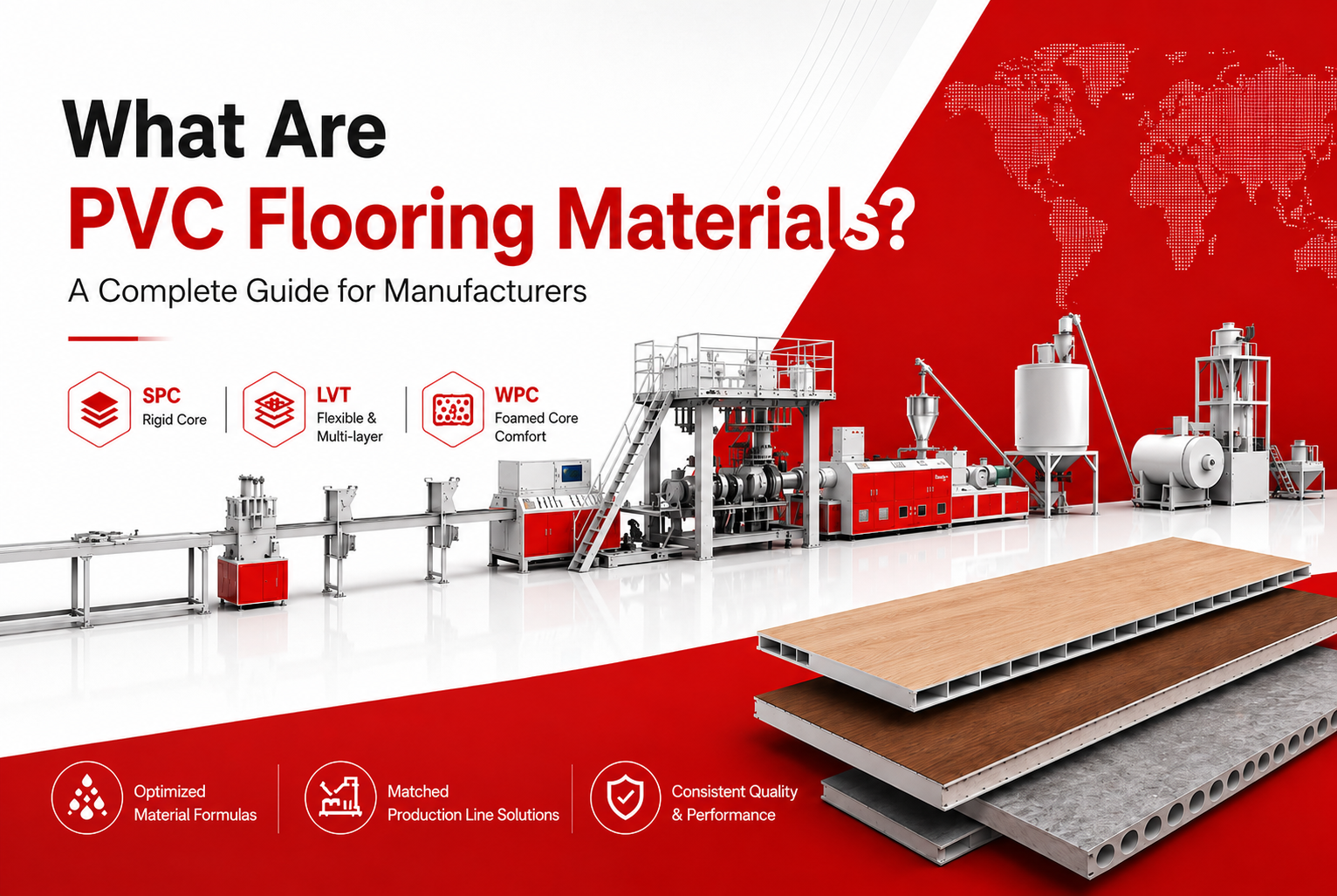
PVC flooring materials form the foundation of modern PVC floor manufacturing, directly influencing both the production process and the performance of the final product. From SPC to LVT to WPC, different flooring types rely on distinct material compositions to achieve their specific properties.
This article introduces the key components of PVC flooring materials and how they are applied across different flooring types, helping manufacturers better understand the relationship between material selection and production line configuration.
What Are the Key Components of PVC Flooring Materials?
Every PVC floor manufacturing formulation is built from the same foundational categories of ingredients:
- PVC Resin
- Calcium Carbonate (CaCO₃)
- Processing Additives (stabilizers, lubricants, modifiers)
PVC Resin is the structural backbone of the entire system. It determines how the material flows through extrusion, how it bonds during lamination, and how the finished board holds up over time. Without the right resin grade for your target product, no amount of additive adjustment will compensate.
Calcium carbonate (CaCO₃) plays a surprisingly critical role. Far from being just filler, it actively adjusts the density, hardness, and dimensional stability of the finished product. In SPC flooring in particular, calcium carbonate is used at high ratios to create the rigid, high-density core that makes SPC boards so dimensionally stable under temperature fluctuations.
Rounding out most formulations are processing additives — stabilizers, lubricants, and modifiers that keep production lines running smoothly. These compounds improve thermal stability, regulate surface appearance, and prevent degradation during high-heat extrusion. Without them, even the best PVC resin and calcium carbonate mix can produce inconsistent output.
How PVC Flooring Materials Are Used in Different Flooring Types
The same base ingredients appear across SPC, LVT, and WPC categories — but the proportions and supporting components shift considerably.
SPC Flooring
SPC flooring relies on a high ratio of calcium carbonate blended with PVC resin to form a dense, rigid core. This is what gives SPC boards their characteristic dimensional stability and moisture resistance. The trade-off is that this high-filler mixture is mechanically demanding to process, requiring equipment specifically built for that load.
LVT Flooring
LVT flooring uses a PVC resin and calcium carbonate base, with DOTP plasticizer added to introduce the flexibility that makes LVT comfortable underfoot and easy to install. Stabilizers and lubricants round out the formulation, supporting the multi-layer composite structure that defines PVC vinyl flooring products in this category.
WPC Flooring
WPC flooring combines an LVT-style surface layer with a foamed PVC core. The foam introduces a lightweight, cushioned structure that improves underfoot comfort and sound absorption. This formulation is the most sensitive to process control — foam density, cell structure, and layer adhesion all depend on tight temperature management throughout production.
Matching Your Materials to the Right Production Line
Understanding how PVC flooring materials are used is only half the picture — the other half is knowing what that means for your equipment. Each formulation type places different demands on the production line, and the three main categories each require a distinct configuration:
- High-filler compounds → SPC extrusion lines
- Flexible multi-layer compounds → LVT extrusionlines
- Foamed core compounds → WPC extrusion lines
SPC Flooring Extrusion Lines
SPC formulations, with their high calcium carbonate content, require a high-torque twin-screw extrusion system. The mechanical load from dense filler ratios is substantial — equipment that can’t maintain consistent screw torque under that pressure will produce boards with density variation and dimensional inconsistency.
LVT Flooring Extrusion Lines
LVT formulations demand high-precision extrusion and lamination systems. Because LVT is a multi-layer composite, any deviation in thickness, temperature, or pressure across the line width shows up directly in surface quality and layer adhesion. Consistency here isn’t a preference — it’s what the structure requires.
WPC Flooring Extrusion Lines
WPC formulations require dedicated foaming control and temperature regulation systems. Foam density, cell structure, and the bond between the foam core and surface layers all depend on how tightly the line manages heat from extrusion through cooling. A system without this control will struggle to produce uniform boards at scale.
Ready to Build Your Line? Here’s What We Recommend
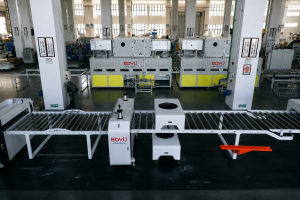
For manufacturers who need production lines engineered around the actual demands of each material type, Boyu Machinery offers purpose-built extrusion lines covering SPC, LVT, and WPC flooring — all CE-certified and configurable with Omron or Siemens PLC control systems.
- SPC Flooring Extrusion Line: Our conical and parallel twin-screw options are designed for high-filler PVC/CaCO₃ compounds, delivering stable board quality and consistent output
- LVT Flooring Extrusion Line: Our precision extrusion technology is built for flexible PVC multi-layer structures, with smooth and uniform surface output
- WPC Flooring Extrusion Line:Our high-output line is engineered for composite PVC foam core structures, with durable and stable board performance
Conclusion
PVC flooring materials are more than a list of inputs — they define what your production line needs to be and what your finished product can deliver. Whether you’re working with rigid SPC compounds, flexible LVT formulations, or foamed WPC structures, the decisions made at the formulation stage directly shape your equipment requirements, process stability, and product quality.
If you’re ready to match your materials to the right production line, get in touch with us — we’re here to help you build it right from the start.