
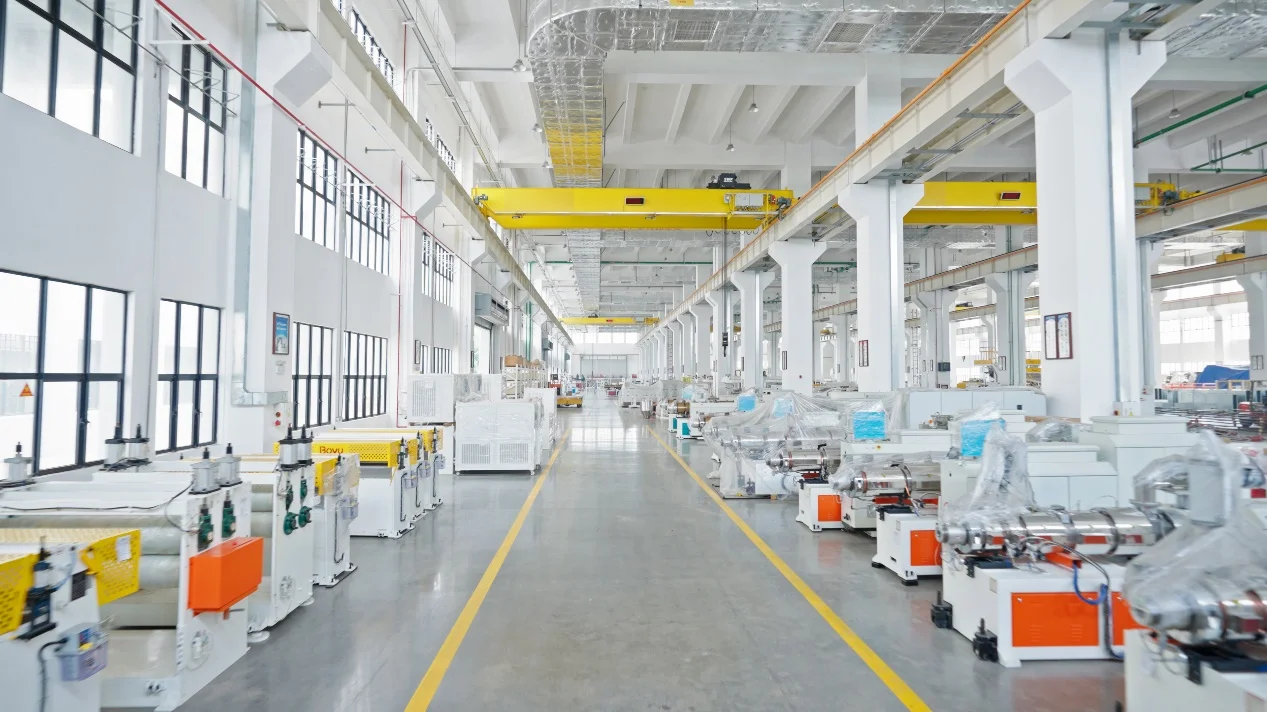
When buying a plastic extruder machine, many customers tend to focus more on output and price, while the readiness of the workshop is easily overlooked. In practice, issues such as output fluctuation or dimensional variation may relate more to workshop conditions than to the plastic extruder machine itself. This article, therefore, outlines some main workshop requirements for a plastic extruder machine, which may help manufacturers prepare before the extrusion line arrives.
Why Does the Workshop Environment Affect Extrusion Production?
Extrusion is a continuous thermal forming process that tends to be sensitive to external conditions. When the workshop falls short, a plastic extruder machine is often affected as follows:
- Unstable power:Voltage fluctuations may cause unstable plasticization and temperature drift, leading to dimensional variation.
- Insufficient cooling:High water temperature or low flow tends to leave sizing incomplete, so sheets or profiles may deform.
- Poor ventilation:Heat accumulation can affect control-system stability and shorten component life.
- Limited space or loading:The extrusion line is harder to arrange reasonably, and later repair and changeover may be restricted.
What Workshop Conditions Does a Plastic Extruder Machine Usually Need?
Space and Ceiling Height
The required floor area usually varies with line type and capacity. In general, the higher the output and the longer the line, the more continuous space it tends to need.
For a sheet and board extrusion line, for example, a room has to be reserved in sequence for the extruder, die head, forming platform, haul-off, and cutting sections. When planning the workshop, it is therefore better to confirm the required area with the supplier based on the actual model and capacity, rather than relying on a single fixed figure.
In addition, leaving around 1–2 meters of clearance around the machine is generally advisable, so that routine inspection and servicing are easier. As for ceiling height, it should take into account the height of auxiliary equipment such as feeding and lifting systems, leaving enough room for later hoisting and maintenance.
Power Supply
A plastic extruder machine draws considerable power, and the screw drive motor alone typically accounts for around 55%–65% of the total. In terms of supply form, most industrial extruders run on three-phase power, usually within a range of about 380V–480V.
Because extrusion is a continuous process, stable voltage and frequency become fairly important; once fluctuations grow large, they may affect operation or even damage electrical components. In terms of efficiency, motors are usually best run at around 70%–85% of their rated load, whereas running below 50% load for long periods tends to cause noticeable energy waste. Proper grounding also helps guard against surges and electric shock.
Further reading: How to Reduce Energy Consumption in Extrusion Production Lines
Cooling Water
Cooling water mainly serves the calibration unit, gearbox, and feed throat, and therefore usually calls for a stable circulating system together with good drainage.
As for common industry benchmarks, PVC extrusion is roughly estimated at about 1 ton of cooling per 80 lbs/hr of output, gearbox cooling at about 1 ton per 100 HP, and the feed throat at around 1–2 tons depending on screw size. Even so, the actual configuration is still best determined together with the real capacity and machine model.
Ventilation, Temperature and Humidity
When plastic is heated during processing, it may release some harmful fumes (such as hydrogen chloride from PVC) and volatile organic compounds (VOCs). For this reason, source capture through local exhaust ventilation is generally preferred, drawing contaminants away near the source before they reach the operating area. In practice, capture hoods are usually best placed within about 1.5 times the duct diameter from the source, while general workshop ventilation is often recommended at around 6–8 air changes per hour.
Beyond ventilation, temperature and humidity also deserve attention. An ambient temperature of about 20°C–25°C is usually suitable; once humidity becomes too high (for example, above 60%), raw materials tend to absorb moisture, which may not only cause defects such as bubbles and voids but also accelerate corrosion of metal parts.
Floor Loading and Foundation
Since extrusion equipment is relatively heavy, a reinforced concrete floor is generally recommended to bear both static and dynamic loads.
At the same time, the floor should ideally stay flat and level, so as to keep vibration to a minimum. If vibration is excessive, it may cause component misalignment, accelerate wear, and further affect product quality.
Compressed Air
Vacuum calibration and pneumatic control need a reasonably stable compressed air supply, and conventional processing generally uses around 7–8 bar.
To keep the air clean, the compressed air is best paired with a refrigerated dryer and filtration to remove oil, moisture, and dust; otherwise, contaminated air may affect printing clarity, lamination adhesion, and the surface quality of finished products. In addition, as plastic workshops often run warm and dusty, the air compressor is generally recommended to offer IP54-level dust protection.
Note: The above figures are general references only; actual specifications should be discussed and determined based on the specific model and capacity.
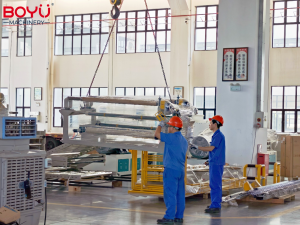
How Does Boyu Machinery Help Customers Prepare?
Workshop conditions cover many factors that first-time investors or those expanding capacity may find hard to judge on their own. Founded in 1998, Boyu Machinery is a China-based plastic extruder manufacturer with nearly 30 years of industry experience and over 120 patents, integrating design, manufacturing, sales, and after-sales service, and holding certifications such as CE and ISO-9001. On this basis, Boyu Machinery supports customers in several practical ways:
- Solutions and customization:Drawing on its own R&D and design capability, Boyu Machinery provides extrusion solutions suited to a customer’s product type and capacity, and the equipment configuration can also be customized to specific needs.
- Installation and optimization:Boyu Machinery’s technical team assists with equipment installation and operational optimization, helping the line reach a stable running state more smoothly.
- Maintenance and troubleshooting:Ongoing maintenance and troubleshooting support help keep the equipment running reliably.
- Global technical support:Backed by its experience serving the global extrusion market, Boyu Machinery provides ongoing technical support and service to customers across different regions.
Final Thoughts
All in all, the workshop environment is as critical as the plastic extruder machine itself. Planning power, cooling, ventilation, and space in advance often helps the whole line reach stable output more smoothly. As a China-based manufacturer with nearly 30 years of experience — integrating design, manufacturing, sales, and after-sales service — Boyu Machinery offers customizable extrusion solutions along with installation, optimization, and maintenance support. If you would like a closer look at your own workshop conditions, contact us — Boyu Machinery’s team is always glad to talk it through.
References
- https://www.osha.gov/laws-regs/standardinterpretations/1982-03-09
- https://eldridgeusa.com/blog/osha-ventilation-requirements-for-industrial-facilities/
- https://www.suequip.com/News/how-to-choose-the-right-air-compressor-for-plastic-manufacturing-a-complete-guide
- https://jiantaimachine.com/plastic-extruder-power-use-in-kwh-explained-with-real-data/