
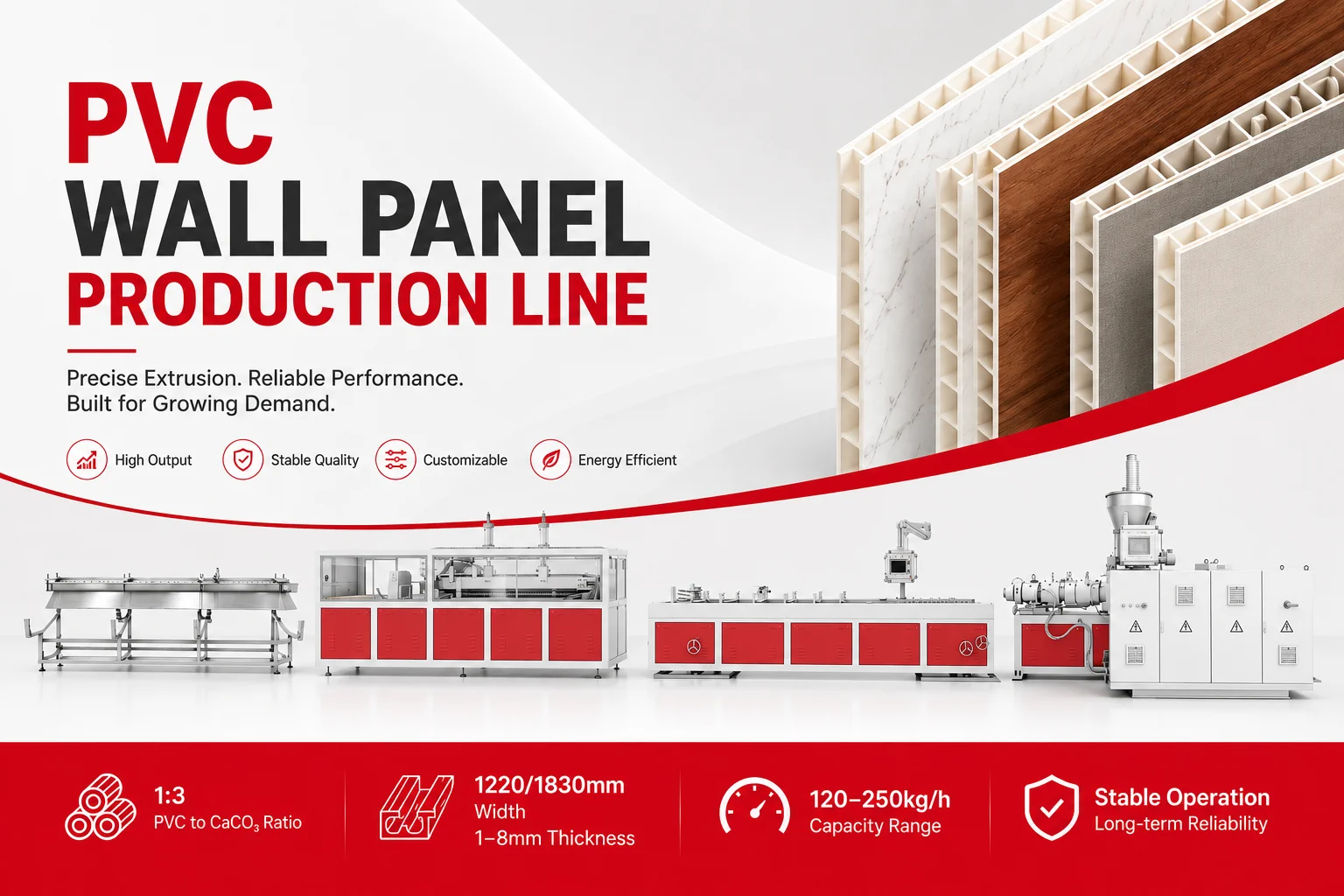
Demand for PVC wall panels keeps climbing across housing, hospitality, healthcare, and prefab construction. Meeting that demand comes down to a dedicated production line that combines several stages of plastic extrusion — melting, shaping, and cooling — into one continuous process. This guide looks at where that demand comes from, how the extrusion process turns raw material into finished panels, and what to look for in a PVC wall panel production line built to keep up.
Applications: Where Demand for PVC Wall Panels Is Growing
Before getting into how a PVC wall panel production line works, it helps to see where that demand actually comes from.
This production line isn’t limited to a single market — it opens the door to several sectors, each with steady demand for wall panels.
- Residential & Rental Housing:Renovation and rental housing projects favor wall panels for one simple reason: they go up faster and leave less mess on site than tile or plaster.
- Commercial & Hospitality: In hotel corridors, retail stores, and office partitions, wall panels give large spaces a uniform look while cutting down on the ongoing upkeep that painted walls require.
- Healthcare & Food Processing: Hospitals and food plants operate under strict hygiene rules, and PVC wall panels offer a moisture-resistant, seamless surface that is one of the most practical ways to meet them — something painted or wallpapered walls struggle with.
- Exhibitions & Prefabricated Buildings:Exhibition booths and prefab structures come and go quickly, so builders need materials light enough to assemble and take apart on tight timelines — and PVC wall panels are light enough to do exactly that.
How a PVC Wall Panel Production Line Works: The Extrusion Process, Step by Step
Turning raw PVC powder into a finished wall panel takes four connected stages, each shaping the panel’s final quality. Here’s how a PVC wall panel production line handles each one:
1.Raw Material Preparation
PVC wall panel production begins with mixing PVC resin, calcium carbonate (CaCO₃) filler, stabilizers, and lubricants. For rigid wall panels, manufacturers typically use a PVC-to-CaCO₃ ratio of around 1:3, balancing rigidity, cost efficiency, and surface finish.
The blended powder is fed into a high-shear mixer to achieve a uniform, moisture-free compound. Even mixing at this stage is essential to prevent bubbles, uneven density, or weak spots in the finished panel.
2.Extrusion and Melting
The prepared compound is fed into the extruder, where rotating screws apply heat and pressure to melt it into a homogeneous molten mass. Precise temperature control across multiple heating zones is required: too much heat degrades the PVC, while too little leaves it under-plasticized.
The molten material is then pushed through the T-die, which shapes it into the wall panel’s cross-sectional profile, including the hollow chambers that reduce weight and material cost. Die design accuracy directly determines the dimensional precision of this profile.
3.Calibration and Cooling
As the panel exits the die, it passes through the calender, where rollers fix its exact shape and dimensions while the material cools and solidifies.
This stage determines the panel’s final thickness accuracy and surface smoothness, both of which directly affect installation quality and appearance.
4.Traction, Cutting, and Stacking
The traction machine then pulls the cooled profile forward at a steady, controlled speed, maintaining consistent wall thickness along its length.
The profile is cut to standard lengths by the cutting machine, then transferred to the automatic fipping & stacker system, which flips and stacks the finished panels, ready for packaging, quality inspection, or further surface treatment such as printing or lamination.
What to Look for in a PVC Wall Panel Production Line
With demand for wall panels spread across so many different sectors, a PVC wall panel production line needs more than just the ability to run — it needs to keep up with orders that vary in size, spec, and volume. Here’s what to pay attention to before you buy.
Width & Thickness Flexibility
Check what range of panel widths and thicknesses the line can actually produce, not just its default setup. Hotel projects, residential renovations, and prefab structures rarely call for the same dimensions, and a line locked to one width or thickness will turn away orders outside that range.
Capacity That Can Scale
Ask whether the extruder model you’re buying has room to grow, or whether hitting higher daily output means replacing the whole line. Most manufacturers start small and take on larger orders over time, so this decision affects how far the same investment can take you.
Dimensional Stability
Look closely at the calibration and temperature control systems, not just the extruder’s rated speed. Buyers in healthcare, food processing, and hospitality will reject panels with inconsistent thickness or an uneven surface, no matter how fast the line runs.
After-Sales Support
A production line is only as good as the support behind it. Before signing anything, get specifics on installation guidance, operator training, and how technical support actually works day to day — for example, whether the supplier sends engineers on-site for installation, how fast they respond to a breakdown, and whether spare parts are readily available.
Further reading :What Factors Should Be Considered Before Selecting an Extrusion Line?
Recommended Equipment: Boyu Machinery’s PVC Profile Production Line
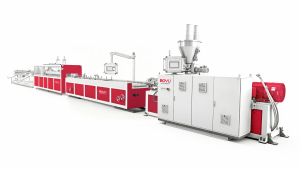
If you’re looking to enter this market, the PVC Profile Production Line from Boyu Machinery is worth considering — it includes a dedicated wall panel configuration, integrating an extruder, T-die, calender, traction machine, cutting machine, and automatic fipping & stacker system into a single line.
- Customizable specifications: 1:3 PVC-to-CaCO₃ ratio, with panel width and thickness (e.g. 1220mm/1830mm, 1–8mm) configurable to your product design.
- Scalable capacity: Three extruder models (SJSZ-48/51, SJSZ-55, SJSZ-65) covering 120–250kg/h, so output can grow with your orders.
- Reliable operation: PLC control system (Omron or Siemens) with a touch-screen interface, CE certified.
- Support included: Installation guidance, operator training, and after-sales technical support.
With these specifications covered, this PVC Profile Production Line is built to handle the range of orders discussed throughout this guide — from a single width to a full production ramp-up.
Ready to Meet the Demand?
A PVC wall panel production line ties every stage of PVC extrusion — from raw material mixing to the final stacked panel — into steady, scalable output. That’s what turns growing demand across housing, hospitality, healthcare, and prefab construction into real orders.
If you’re considering entering the PVC wall panel market, what’s holding you back the most right now — finding the right equipment, understanding the specs, or something else? Let us know in the comments below.
Boyu Machinery’s PVC Wall Panel Production Line is built to help you meet this demand — contact us for a quote and technical details.