
Are you planning a new plastic extrusion line but unsure which machine to invest in? Understanding the difference between single and twin screw extruder systems is the critical first step. While both melt and form plastic, their capabilities vary wildly.
This guide will explore their key differences in working principles, mixing capabilities, material suitability, and equipment costs—helping you determine when a single screw is sufficient, and why a twin screw extruder is the preferred choice for complex and high-filler formulas.
What Is a Single Screw Extruder?
A single screw extruder uses one rotating screw inside a heated barrel to melt, convey, and push material through a die. It is the most widely used type of plastic extruder and has a long history of industrial application.
Advantages
- Simpler structure, easier to operate and maintain
- Lower equipment and spare parts cost
- Well-suited for continuous forming processes using pre-compounded pellets
- Widely proven and well-understood in the industry
Limitations
- Limited mixing and dispersion capability — generally not suitable for blending or compounding
- Difficult to feed powder materials directly; usually requires pre-pelletized feedstock
- Less process flexibility — screw design is typically fixed
- Fewer adjustment options for residence time, shear intensity, and temperature profile
Common Applications
- Pipe extrusion (PE, PP-R, PVC with pre-compounded pellets)
- Sheet and film extrusion (PP, PE, PET, PS)
- Profile extrusion (simple cross-sections using pre-compounded material)
- Wire and cable coating
What Is a Twin Screw Extruder?
A twin screw extruder uses two intermeshing screws — either co-rotating or counter-rotating, and either parallel or conical in shape. The intermeshing design creates forced conveying and active mixing, enabling direct powder processing and complex multi-component formulas.
Advantages
- Strong mixing and dispersion — well-suited for blending additives, fillers, and colorants into the polymer
- Can process powder materials directly, without pre-pelletizing
- Generally supports higher output at equivalent screw sizes
- More process control options — temperature, residence time, shear, and feed rate can be adjusted independently
- Produces more consistent melt quality, benefiting downstream equipment stability
Limitations
- Higher initial equipment investment
- More demanding in terms of operation and maintenance
- To fully utilize its output capacity, downstream equipment must be properly matched
Common Applications
- SPC, WPC, and LVT flooring extrusion
- PVC profile and window frame extrusion
- PVC foam board and decorative panel extrusion
- Wood-plastic composite extrusion
- High-filler compound processing
Single Screw Extruder vs Twin Screw Extruder: Side-by-Side Comparison
| Dimension | Single Screw Extruder | Twin Screw Extruder |
| Screw structure | One screw | Two intermeshing screws (parallel or conical) |
| Feeding | Suitable for pellets; limited with powder | Handles powder, pellets, and high-filler materials |
| Mixing & dispersion | Limited | Strong; adjustable through screw element configuration |
| Plasticizing | Adequate for pre-compounded materials | Better for raw powder formulas and multi-component blends |
| Output capacity | Moderate | Generally higher at equivalent screw size |
| Process flexibility | Lower; fixed screw design | Higher; screw configuration can be adapted |
| Energy efficiency | Favorable for simple melting | Often more efficient in high-fill scenarios |
| Equipment cost | Lower | Higher |
| Maintenance | Simpler | More demanding |
| Material suitability | PE, PP, PS, PET (pellets) | PVC powder, CaCO₃-filled formulas, WPC |
| Best for | Simple melting and forming | Demanding formulas, powder processing, high-output lines |
How to Choose: What Determines the Extruder Type?
Choosing the right extruder isn’t about which machine is “better,” but which one fits your specific production goals. Here are the three main factors that should guide your decision:
- Material Form and Formula Complexity: This is the most decisive factor. If you are processing pre-compounded pellets with a simple formula, a single screw extruder is usually sufficient. However, if your process starts with dry powder (like PVC blend) or includes high amounts of calcium carbonate (CaCO₃) and other fillers, a twin screw extruder is necessary for stable feeding and intensive mixing.
- Processing Tasks Required: What exactly does the machine need to do? If the goal is strictly to melt and form the plastic, a single screw works perfectly. If the process requires blending, dispersing additives, devolatilization (venting gases), or precise temperature control for heat-sensitive materials, the active mixing of a twin screw design is essential.
- Full Production Line Matching:Never choose an extruder in isolation. The extruder determines the melt quality and flow rate that the T-die, calender (or calibration system), traction machine, and cutting machine will receive. A powerful extruder paired with undersized downstream equipment will cause bottlenecks and unstable production.
Why Partner with Boyu Machinery?
As mentioned, selecting an extruder in isolation often leads to production bottlenecks. When investing in twin screw extrusion, buying a standalone machine isn’t enough to guarantee success. You need a complete, synchronized production system. Boyu Machinery provides fully integrated turnkey solutions designed to maximize your output and product quality.
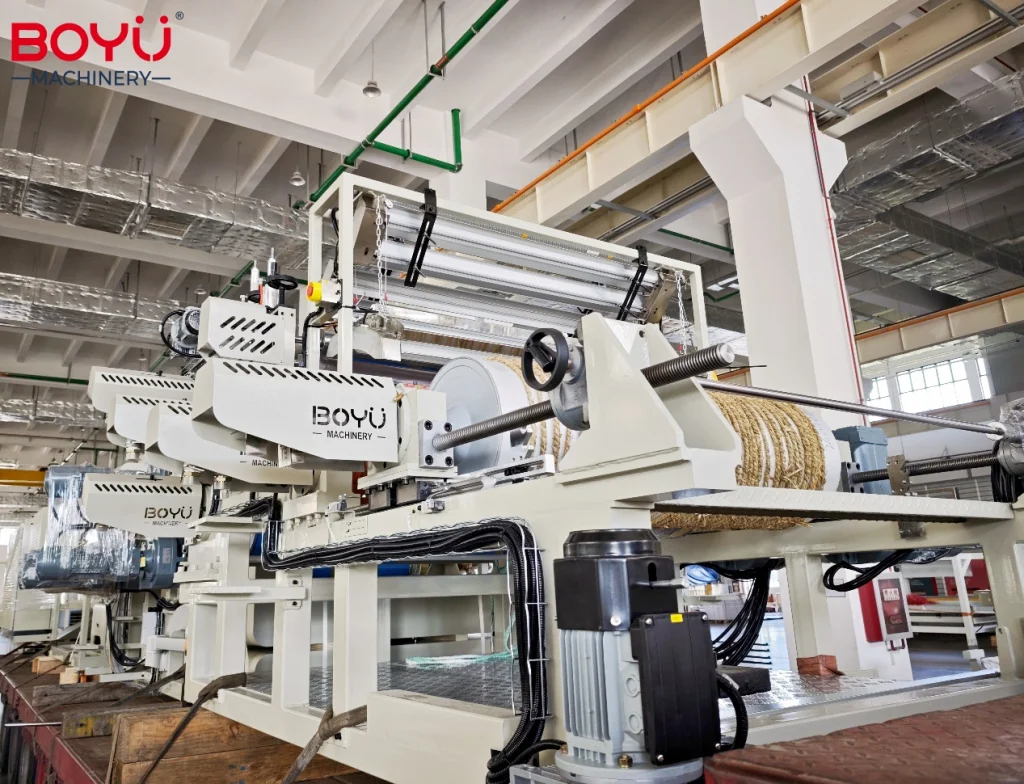
Here is what sets us apart:
- Nearly 30 Years of Industry Expertise: Decades of proven experience in designing and manufacturing high-performance extrusion equipment.
- True Turnkey Production Lines: We don’t just sell extruders. We provide the complete package tailored to your final product. Whether your line requires an extruder, T-die, calender, traction machine, cutting machine, and automatic flipping & stacker system for boards, or specialized calibration systems for profiles, every component is perfectly matched for seamless operation.
- Advanced Twin Screw Technology: Our extruders are specially optimized for processing PVC powder and high-filler formulas (like CaCO₃), ensuring excellent mixing, stable output, and lower energy consumption.
- Tailored to Your Formula: We customize the screw configuration and line layout based on your specific material properties and capacity targets.
Explore our core extrusion line solutions:
- SPC Flooring Extrusion Line
- PVC Foam Board Extrusion Line
- PVC Profile Production Line
- PVC door panel extrusion machine
- PVC door frame extrusion machine
- PVC door profile extrusion machine
- PVC ceiling panle extrusion machine
- PVC fluted panel extrusion machine
Beyond these core solutions, we offer a wide variety of specialized extrusion equipment. View our full product catalog to explore all our machines.
The Final Verdict: Choosing Your Extrusion Path
Ultimately, your material dictates the machine. While single screws handle simple pellets, a twin screw extruder is your best investment for high-filler powder formulas. Boyu Machinery delivers highly customized, turnkey extrusion lines synchronized for maximum yield.
What material are you processing next, and which extruder fits your goals?
Ready to eliminate bottlenecks and boost capacity? Contact Boyu Machinery today for a customized extrusion solution!
FAQ
Can I just replace my single screw extruder with a twin screw extruder on an existing line?
Generally, no. A twin screw extruder’s higher output will overwhelm older downstream equipment, causing production bottlenecks. True capacity upgrades require a matched extrusion line.
Why is a twin screw extruder generally more expensive, and is the investment worth it?
The higher initial cost comes from complex mechanics like the precision gearbox and dual screws. However, it pays off quickly. Processing cheaper dry powders directly and achieving higher outputs significantly lowers your overall production cost per kilogram.
Once I decide on a twin screw extruder, how do I choose between conical and parallel designs?
Conical extruders offer stable pressure for PVC profiles, while parallel extruders provide higher throughput and intense mixing for SPC or board production. Read our Conical vs. Parallel guide for details.