
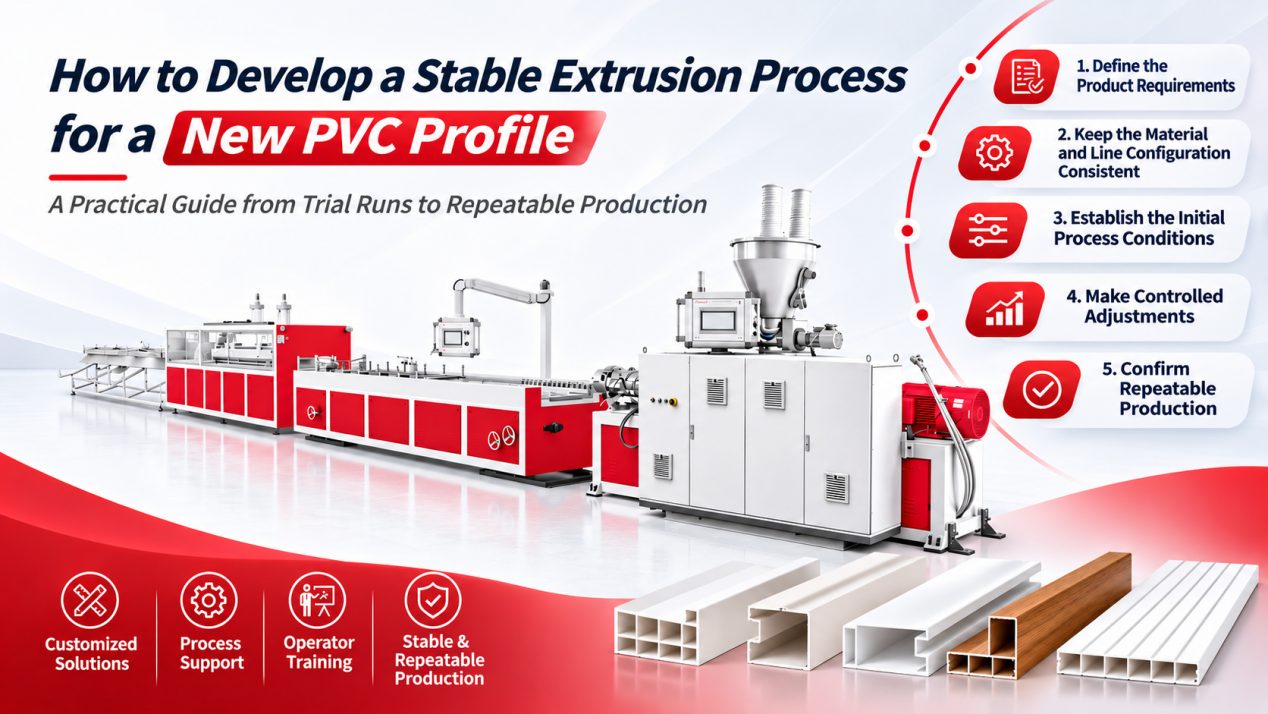
Developing a new PVC profile requires more than copying settings from an existing product. Changes in cross-section, wall thickness, cavities, compound or output target can affect material flow, cooling and final dimensions. A stable PVC profile extrusion process must therefore be developed around the actual product. The following steps explain how to configure and adjust a PVC profile extrusion line before a new profile moves from initial trials into repeatable production.
1. Define the Product Requirements
Before configuring the line or setting process parameters, collect the following product information:
- A dimensioned cross-section drawing with critical tolerances
- Minimum and maximum wall thicknesses, hollow chambers and locking features
- Target weight per meter, straightness and cutting length
- Surface, color and application requirements
- Intended PVC compound, target output and expected line speed
These requirements provide the basis for selecting the line configuration, developing the tooling and evaluating trial samples.
2. Keep the Material and Line Configuration Consistent
Rigid PVC compounds generally contain PVC resin, calcium carbonate, stabilizers, lubricants and other processing additives. Changes in the compound can affect feeding, fusion, material flow, cooling and shrinkage. The material conditions should therefore remain consistent during each trial. If the compound changes, the process settings should be checked again.
The complete PVC profile production line should also be treated as one connected system:
- Match the conical twin-screw PVC extruder to the compound and required stable output
- Match the die and forming tooling to the profile cross-section
- Configure the calibration and cooling section for the profile size and intended speed
- Synchronize the haul-off with the extrusion output
- Set the cutting unit for the required finished length
3. Establish the Initial Process Conditions
Allow the barrel and die temperatures to stabilize before feeding material. Start with controlled screw speed and output, establish the vacuum progressively, and confirm that the cooling-water system is operating correctly.
Adjust the haul-off speed according to the actual extrusion condition so that the profile passes through the calibration section without excessive stretching or compression. Increase output gradually only after material exits the die continuously without surging or visible unfused particles, the profile enters the calibrator without folding, dragging or lateral deviation, and the initially cooled samples show no warpage, cross-sectional distortion or obvious surface defects.
4. Make Controlled Adjustments
Inspect wall thickness, weight per meter, surface finish, cavity shape, straightness and fitting dimensions during the trial. Take final dimensional measurements after the profile has cooled sufficiently, because further shrinkage may occur after it leaves the calibration section.
If a result falls outside the required range, adjust one main variable at a time whenever practical. Allow the PVC extrusion process to stabilize before collecting another sample. If reasonable changes to temperature, screw speed, vacuum, cooling or haul-off speed do not solve the problem, inspect the die and calibration tooling.
5. Confirm Repeatable Production
Producing one acceptable sample does not prove that the process is stable. Continue operating the PVC profile extrusion line and inspect samples at suitable intervals. Confirm that output, dimensions, weight, surface quality and equipment operation remain consistent.
After verification, the production team should record the validated settings and normal operating ranges for future production runs.
Further reading: Top 5 Tips to Improve Extrusion Process Stability in Manufacturing
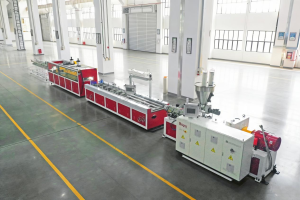
Why Choose Boyu Machinery for PVC Profile Extrusion?
Founded in 1998, Boyu Machinery supplies PVC profile extrusion equipment for a wide range of manufacturing applications. For example, available solutions include a PVC door panel extrusion machine, a PVC door frame extrusion machine, a PVC door profile extrusion machine, a PVC ceiling panel extrusion machine and a PVC fluted panel extrusion machine.
Rather than applying one standard configuration to every product, Boyu Machinery configures each line according to the profile drawing, product dimensions, material, target output and automation requirements. Its PVC profile lines integrate conical twin-screw extrusion, customized tooling, multi-zone vacuum calibration and PLC touch-screen control, with Omron or Siemens control options and Schneider low-voltage components.
Boyu Machinery also provides formulation guidance, calibration-tooling design, installation guidance and operator training. Backed by 120+ patents, ISO 9001-certified manufacturing and a 60,000 m² modern production facility, Boyu Machinery provides global manufacturers with customized PVC profile extrusion lines and integrated project support for a broad range of profile production requirements.
Move from Trial Runs to Stable PVC Profile Production
Stable PVC profile production depends on clear product requirements, consistent materials, a properly matched line, controlled adjustments and validated operating settings. Boyu Machinery provides customized PVC profile extrusion lines configured around the profile drawing, product dimensions, target output and automation requirements.
Which part of your new profile project is most challenging: initial setup, dimensional control, cooling, or repeatable production across batches? Share your drawing and production requirements with Boyu Machinery to discuss a suitable solution.