
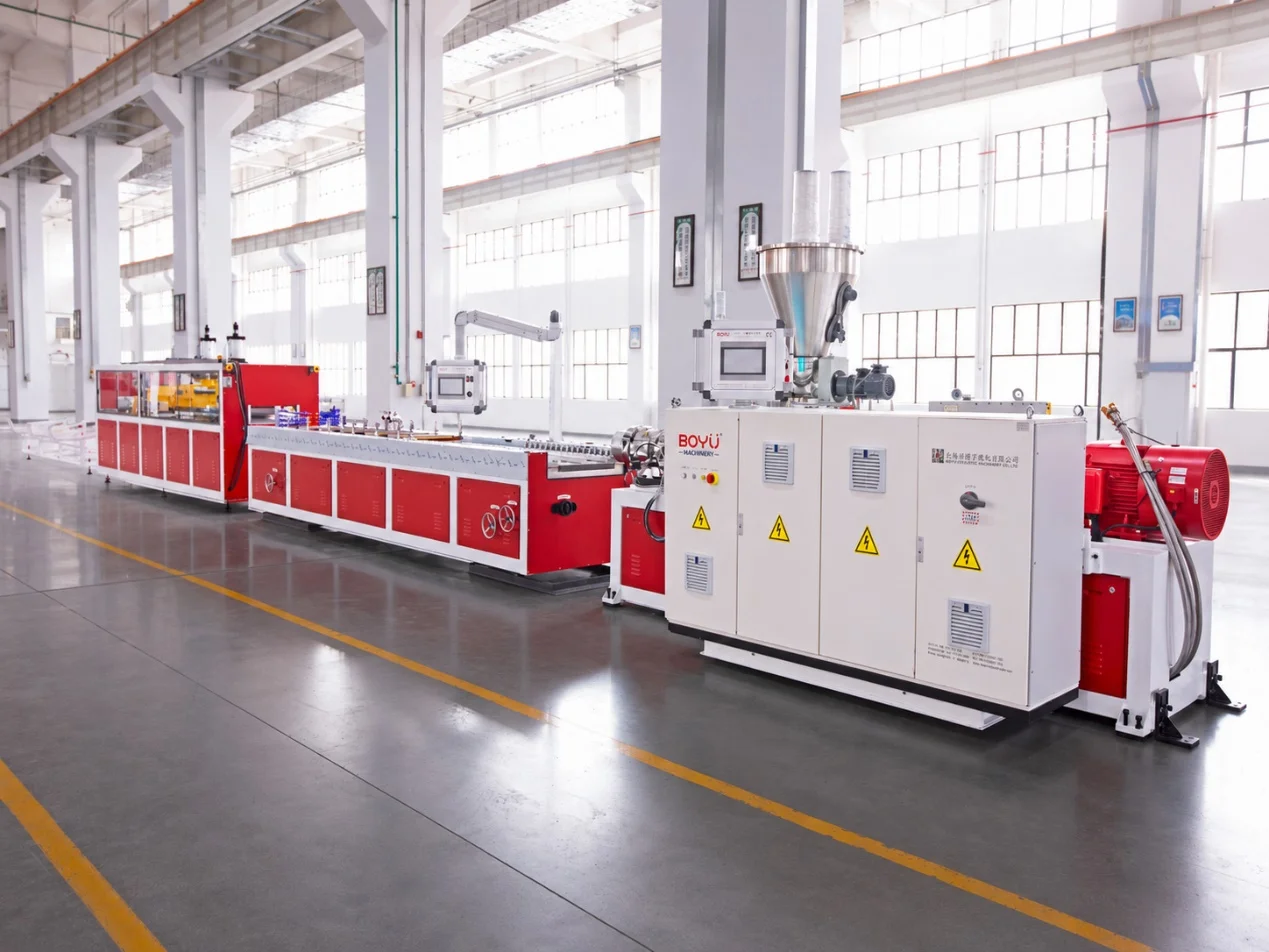
Vacuum calibration is a shaping and sizing process that takes place immediately after extrusion. Its purpose is to give the soft, newly extruded PVC profile its final cross-sectional dimensions, wall thickness, and surface quality — and to hold that shape until the material has fully solidified. Without this process, PVC profiles would lose their geometry within seconds of leaving the die.
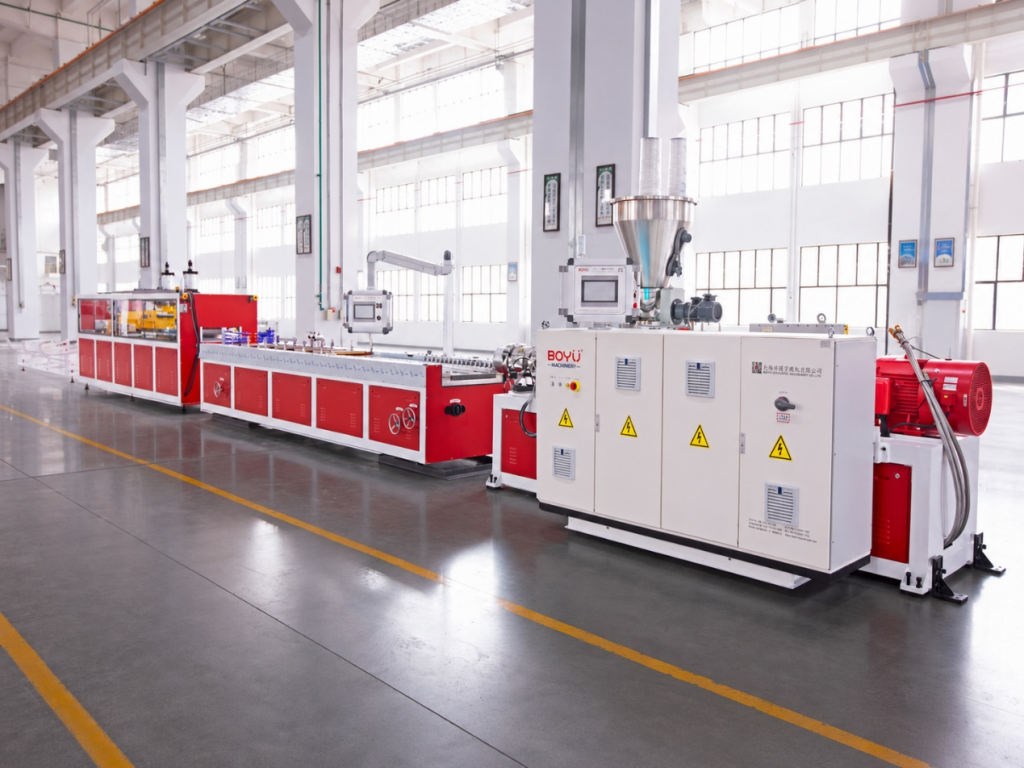
What Is Vacuum Calibration?
Vacuum calibration is a shaping and sizing process that takes place immediately after PVC profile extrusion. Its purpose is to give the soft, newly extruded PVC profile its final cross-sectional dimensions, wall thickness, and surface quality — and to hold that shape until the material has fully solidified. Without this process, PVC profiles would lose their geometry within seconds of leaving the die.
How Vacuum Pressure Shapes the PVC Profile
Inside the calibration unit, a vacuum pump removes air from the chamber surrounding the profile. This creates a pressure differential between the atmosphere and the calibration cavity. The higher atmospheric pressure on the inside of the profile pushes the soft PVC outward against the calibrator walls, forcing it to conform to every contour of the tooling.
To maintain consistent control, advanced calibration tables use multiple vacuum zones along the table length — applying stronger vacuum near the die where the material is softest, and gradually reducing it downstream as the profile solidifies.
How Calibration and Water Cooling Work Together
Once the vacuum holds the PVC profile against the calibrator walls, water cooling solidifies it in that shape. Chilled water flows through channels inside the calibrator body, removing heat through the contact surface. The tighter the vacuum contact, the more efficient the heat transfer — so the two systems must always be adjusted together. When either parameter is off balance:
- Vacuum too weak: Profile does not press firmly against the cooled wall — cooling becomes uneven, dimensions drift.
- Vacuum too strong:Excessive friction causes surface marks; thin walls may deform or tear.
- Water too cold: Outer skin freezes while the core stays soft — internal stresses lead to cracking or warping.
- Water too warm: Profile stays soft too long and deforms downstream.
Why Complex PVC Profiles Need Accurate Calibration
Different profile types present different calibration challenges:
Hollow multi-cavity profiles (door panels, door frames, door profiles)
These contain internal chambers separated by thin partition walls. The main risk is cavity collapse — if external vacuum is not carefully balanced, chambers can flatten, or partition walls can shift. For multi-cavity door frames, internal air pressure is often applied through the die to support the chambers from inside while the external vacuum shapes the outer surface.
Wide thin-walled profiles (ceiling panels)
Their large width-to-thickness ratio makes them prone to bowing and warping. Calibration must ensure even contact and cooling across the full width, not just at the edges.
Ribbed and fluted profiles (fluted panels)
Regularly spaced ribs or flutes require the vacuum to pull material evenly into each channel. Any imbalance causes uneven rib height or wall thickness variation across the panel.
In every case, calibration tooling must be precision-engineered to match the specific profile geometry — a universal calibrator cannot handle these demands.
Common Vacuum Calibration Problems
Most calibration issues result from the interaction of multiple variables. Here are the most frequent problems and their solutions:
- Dimensions out of tolerance:Adjust vacuum level zone by zone; check haul-off speed synchronization with extruder output.
- Surface drag lines: Polish or replace worn calibrator inserts; verify adequate water flow.
- Hollow cavities collapsing:Reduce vacuum pressure; apply internal air support through the die.
- Warping or bowing after cutting:Balance cooling water flow and temperature across all zones.
- Inconsistent wall thickness:Realign the die and calibrator; inspect for wear on both components.
The best practice is to adjust one parameter at a time and observe the result before making further changes.
Why Calibration Must Work With the Complete Extrusion Line
Vacuum calibration does not operate in isolation. The extruder determines melt temperature and output stability. The die defines the starting profile geometry. The haul-off unit controls line speed and must be precisely synchronized with the calibration process. The cutter must not apply force that deforms the still-warm product.
When any one component is out of balance, calibration quality suffers — no matter how well the calibration table itself is set up. This is why a fully integrated production line, where every component is designed and tuned as a unified system, consistently outperforms a line assembled from separate suppliers.
Get It Right From the Start: Boyu Machinery PVC Profile Production Line
Boyu Machinery delivers fully integrated extrusion solutions built for precision calibration. Depending on your target product and capacity, we offer complete production lines for:
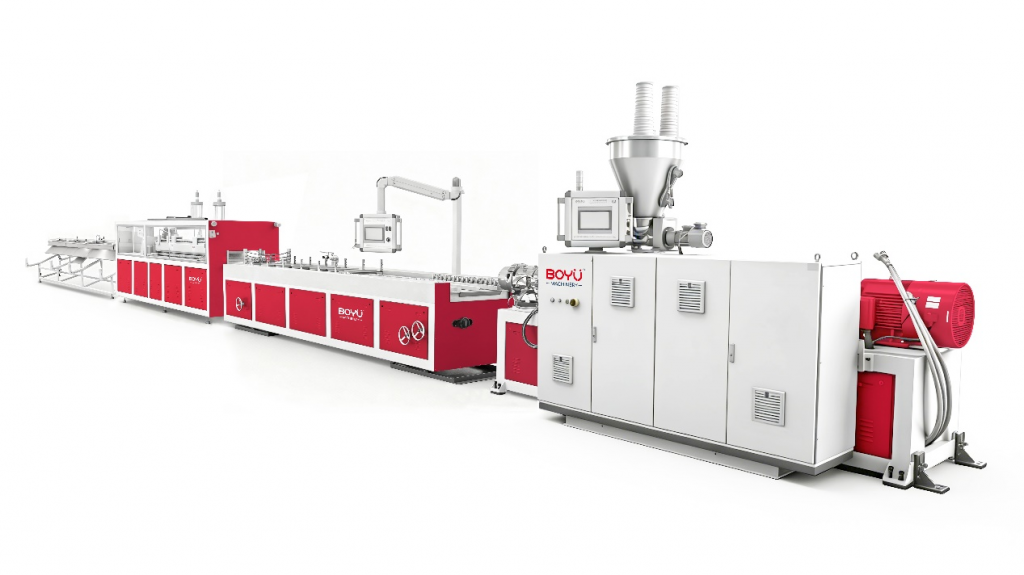
- PVC door panel extrusion
- PVC door frame extrusion
- PVC door profile extrusion
- PVC ceiling panel extrusion
- PVC fluted panel extrusion
All of our PVC Profile Production Lines feature conical twin-screw extruders for stable PVC processing, multi-zone vacuum calibration tables with tooling customized to your specific profile design, and PLC control with a touch-screen interface (Omron or Siemens). Schneider electrical components ensure long-term reliability.
With nearly 30 years of extrusion expertise, Boyu Machinery provides complete turnkey projects — from formulation guidance and calibration tooling design to installation and operator training. Every component is engineered to work together as a system, so your calibration delivers consistent, high-quality profiles from day one.
Final Thoughts: The Key to Consistent Profile Quality
Vacuum calibration plays a critical role in securing profile quality. While the die creates the initial shape, it is the calibration and cooling process that ensures this shape remains stable and accurate during continuous production. Properly balancing vacuum pressure, cooling efficiency, and line speed is essential for maximizing product yield and minimizing setup time.
Still have questions? You may be wondering:
- What vacuum settings are best for my specific profile design?
- How should the calibration tooling be configured for my product dimensions?
- What output capacity can I expect with my material formulation?
These answers depend on your exact product requirements. Contact Boyu Machinery with your profile drawings and production targets — our engineering team will provide a customized solution.