
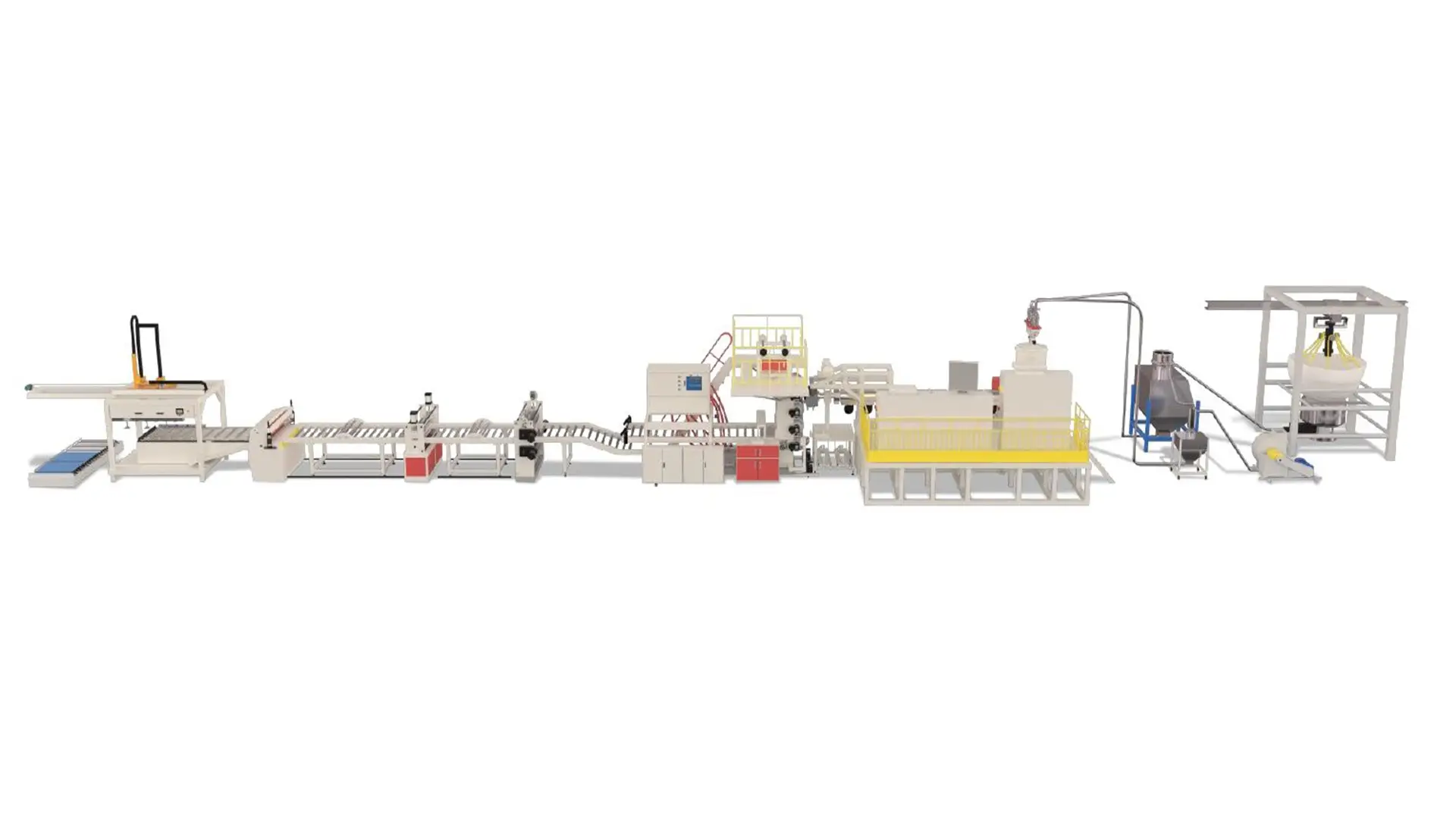
A consistent surface gloss is an important quality target for modern flooring manufacturers. Buyers may accept small variations in mechanical properties during production, but visible differences in sheen can quickly affect product appearance and customer perception. For non-PVC flooring, maintaining a stable surface requires coordinated control of formulation, extrusion, T-die forming, calendering, cooling, and handling. We design our equipment around this continuous process so manufacturers can pursue stable appearance as well as reliable output.
Start with Stable Material Preparation
Gloss consistency begins before material reaches the extruder. Our non-PVC flooring extrusion line is designed to process PET/PP powder, calcium carbonate, stabilizer, lubricant, and other minor materials. The published design parameters specify a PET/PP-to-calcium-carbonate main material proportion of 1:3.
Changes in filler concentration, additives, moisture, or material distribution can alter melt behavior and ultimately influence how the surface responds to calendering. That is why production teams should establish controlled feeding procedures and avoid unnecessary variation between batches.
Control Extrusion Conditions Carefully
The extruder establishes the thermal and mechanical conditions under which the formulation becomes a workable melt. Temperature zones, screw speed, feed rate, and residence time should be monitored together rather than adjusted independently.
Our PVC free flooring extrusion line uses PLC-based control with a touchscreen interface. The available control configuration includes Omron or Siemens PLCs, while Schneider low-voltage electrical components and Inovance, ABB, or Siemens frequency inverters are specified on the product page.
Precise process control helps operators maintain repeatable conditions from one production run to another. This is particularly important when a manufacturer is targeting a uniform appearance across large flooring batches.
Make Calendering a Key Quality Checkpoint
Calendering has a direct role in surface formation because the sheet passes through controlled rolls before becoming the finished flooring substrate. Roll temperature, pressure, speed, surface condition, and gap settings should therefore be monitored as a coordinated system.
Our equipment sequence places the calender after the T-die and before traction, cutting, and stacking. This continuous arrangement allows manufacturers to control the material from extrusion through surface forming without unnecessary handling between stages.
For consistent gloss, production teams should also inspect roll surfaces regularly. Deposits, scratches, contamination, or wear can create localized changes in surface texture that become visible as differences in reflected light.
Keep Thickness and Cooling Stable
Surface appearance cannot be separated completely from dimensional stability. Uneven thickness can influence cooling behavior and mechanical stress across the sheet, potentially contributing to visual differences after production.
The non-PVC flooring extrusion line is specified for products with widths of 985, 1,220, or 1,860 mm and thicknesses from 3 to 9 mm. Its BOYU-A model uses a Φ138 screw, with a listed output of 30–40 tons per day and operating power of approximately 280 kW.
These specifications provide manufacturers with a defined production framework, but actual process settings still need to be established according to the formulation and product design. Stable traction and cooling conditions help preserve the geometry created during calendering.
Manage Line Speed and Traction
Line speed should be treated as a quality parameter rather than only a productivity setting. Increasing speed changes the time available for forming, cooling, and stabilization. If the rest of the process is not adjusted accordingly, surface characteristics may become less consistent.
Traction equipment follows the calender in our integrated line. This allows the sheet to move continuously toward cutting and automatic stacking. For manufacturers, monitoring the relationship between extrusion rate, calender speed, and traction speed can help reduce process fluctuations.
A practical approach is to establish validated operating windows instead of relying on one nominal speed. Operators can then identify abnormal changes before a large quantity of flooring is produced outside the required appearance specification.
Inspect Gloss Consistently
Gloss control requires repeatable inspection. Production teams should define where and how gloss is measured, maintain consistent measurement conditions, and compare results against an approved reference sample or product specification.
Visual inspection remains useful, particularly for identifying streaks, patches, uneven textures, or other defects. However, instrumental measurement can provide more objective data when gloss consistency is a critical customer requirement.
We recommend recording inspection results together with production parameters. If gloss changes, the team can then investigate material batches, temperatures, roll conditions, line speed, or other process variables instead of treating the issue as an isolated surface defect.
Integrate Quality Control Across the Line
A modern PVC free flooring extrusion line should be managed as one production system. The published Boyu configuration integrates extrusion, T-die forming, calendering, traction, cutting, and automatic flipping and stacking. This continuous structure supports coordinated control from raw material processing to finished-floor handling.
We also specify CE-certified fabrication and electrical components for this line, while the product information highlights stable operation, intelligent control, and consistent thickness and density control. These features provide a foundation for repeatable production, but disciplined process management remains essential.
Building More Consistent Flooring Production with Boyu
Gloss consistency is ultimately the result of many controlled variables working together. Material preparation, extrusion conditions, T-die forming, calendering, cooling, traction, and inspection all influence the finished surface. A manufacturer that monitors only one stage may miss the actual source of variation.
Boyu‘s non-PVC flooring extrusion line integrates these production stages into one continuous solution and is designed for different material formulations and board specifications. We focus on precise control, stable operation, and practical production integration so customers can build repeatable manufacturing processes.
For flooring manufacturers, the objective is not simply to achieve an attractive surface once. It is to reproduce that appearance across batches, production shifts, and customer orders. By combining appropriate equipment configuration with controlled processing and systematic inspection, we can help manufacturers establish a stronger foundation for consistent, high-quality non-PVC flooring production.