
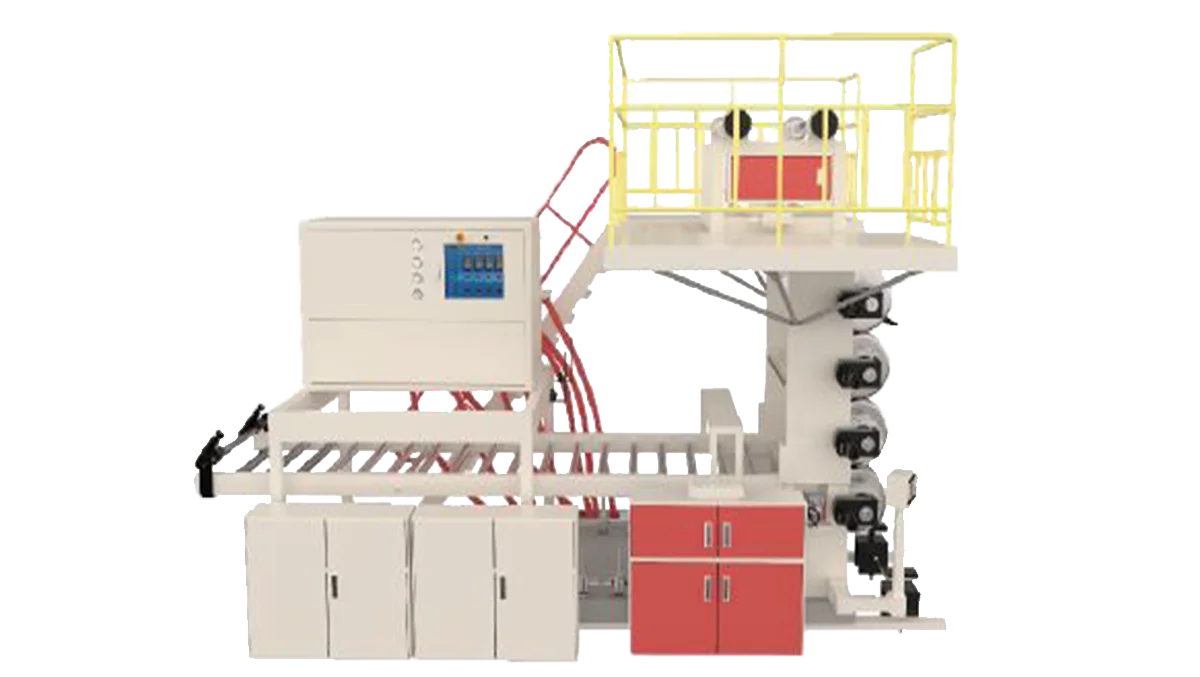
Flooring manufacturers are increasingly exploring non-PVC materials to meet changing product requirements and sustainability goals. Yet replacing PVC with materials such as PET and PP can introduce new processing considerations, particularly around thermal history, residual stress, shrinkage, and dimensional stability.
For this reason, an inline annealing stage can become an important part of a modern non-PVC flooring extrusion line. We at Boyu focus on integrating stable processing equipment and controlled production stages to help manufacturers achieve consistent flooring quality.
Why Annealing Matters in Non-PVC Flooring Production
Thermoplastic materials do not simply become dimensionally stable when they leave an extrusion die. Cooling, molecular orientation, crystallization, and residual stress can continue to influence the finished product. Research on extruded polymers shows that differences in cooling conditions can contribute to residual stress, while annealing can help release stresses generated during processing.
This consideration is particularly relevant when producing rigid flooring from semi-crystalline materials such as PET or PP. Their thermal and structural behavior can change during subsequent heating. Studies have shown that annealing can alter crystallinity and dimensional stability, although excessive or unsuitable thermal treatment can also cause deformation.
For manufacturers, the objective should therefore not be simply to add heat. The goal is to establish a controlled thermal treatment that complements the extrusion and cooling process.
Integrating Annealing into a PVC Free Flooring Extrusion Line
An effective PVC free flooring extrusion line should be considered as a complete production system rather than a collection of independent machines. Our Boyu Non-PVC Flooring Extrusion Line includes an extruder machine, T-die machine, calendaring machine, traction machine, floor cutting machine, and automatic flipping and stacker machine.
An inline annealing section can be positioned as part of the downstream process, depending on the material formulation, product structure, and required production conditions. The exact temperature, residence time, and handling method should be established through material-specific trials rather than applying one universal setting.
This integrated approach allows manufacturers to evaluate extrusion, forming, cooling, and annealing as connected stages. Such coordination is essential because the thermal history created by one stage can influence the behavior of the next.
Controlling Temperature Rather Than Simply Increasing It
Temperature is the most important parameter in an annealing process, but higher temperatures are not automatically better. Semi-crystalline polymers can undergo additional crystallization or structural reorganization during annealing, potentially changing their dimensions and mechanical behavior. Research on PET and other thermoplastics demonstrates that annealing effects are strongly dependent on temperature and treatment time.
For a production line, manufacturers should therefore establish an appropriate operating window through testing. The process should provide sufficient heat for stress relaxation or desired structural development without approaching conditions that could cause unwanted deformation.
A controlled heating profile can also help reduce abrupt thermal gradients. This matters because uneven temperature distribution can contribute to non-uniform dimensional changes as flooring products move through the line.
Supporting Consistent Thickness and Density Control
Flooring products require more than an attractive surface. Consistent thickness and density are important for downstream cutting, installation, packaging, and customer expectations. Variations can originate from extrusion, calendering, cooling, or subsequent thermal treatment.
Our non-PVC flooring extrusion line is designed around consistent thickness and density control. The production system combines extrusion and calendaring equipment to help manufacturers establish a stable sheet-forming process before downstream handling and finishing.
An inline annealing system should complement, rather than disrupt, this consistency. If the flooring enters the annealing stage with uneven thickness or temperature distribution, thermal treatment may amplify dimensional differences. Proper upstream process control is therefore just as important as the annealing equipment itself.
Matching Annealing to PET and PP-Based Formulations
Our PVC free flooring extrusion line is designed to process raw materials including PET/PP powder, calcium carbonate, stabilizer, lubricant, and small materials. Because PET and PP have different thermal characteristics, manufacturers should not assume that an identical annealing recipe will work for every formulation.
Research on polypropylene indicates that annealing can influence crystalline structure and help diminish residual stress, while PET studies show that controlled thermal treatment can affect crystallinity and dimensional stability.
For commercial production, the appropriate settings should therefore be validated against the actual formulation, thickness, line speed, and finished-product requirements. This material-specific approach can help manufacturers avoid unnecessary trial-and-error during scale-up.
Designing for Continuous Production Efficiency
An inline system has an important advantage over a completely separate post-production treatment: thermal conditioning can be incorporated into the continuous manufacturing workflow. This can reduce additional handling and allow manufacturers to consider dimensional stabilization as part of the original production process.
Our complete PVC free flooring extrusion line has a total power specification of 520KW and incorporates professional equipment from extrusion through automatic flipping and stacking. For manufacturers, integrating thermal treatment into such a coordinated system can support more streamlined production management.
At the same time, productivity should never be considered separately from quality. A faster line speed may reduce residence time in an annealing section, while slower operation increases thermal exposure. Manufacturers should balance throughput and treatment requirements during commissioning.
Building a More Stable Non-PVC Flooring Process with Boyu
Annealing can provide valuable control over the thermal history of non-PVC flooring, but its success depends on accurate temperature management, appropriate residence time, and coordination with upstream and downstream processes. Research confirms that thermal treatment can influence residual stress, crystallization, and dimensional behavior, making process optimization essential.
We at Boyu provide an integrated non-PVC flooring extrusion line with extrusion, T-die, calendaring, traction, cutting, and automatic stacking equipment. Designed for eco-friendly flooring production and consistent thickness and density control, our system processes PET/PP powder, calcium carbonate, stabilizer, lubricant, and small materials. By treating annealing as part of the complete process, manufacturers can work toward more stable, efficient, and consistent flooring production.
Making Thermal Stability Part of Production Strategy
For manufacturers moving beyond conventional PVC flooring, thermal management deserves careful attention. An appropriately designed inline annealing stage can help address residual stress and structural changes while keeping treatment within a controlled production workflow.
We believe the strongest results come from viewing the PVC free flooring extrusion line as an integrated system. With coordinated processing, material-specific testing, and controlled thermal treatment, our Boyu equipment can provide a practical foundation for manufacturers seeking reliable non-PVC flooring production and long-term manufacturing efficiency.