
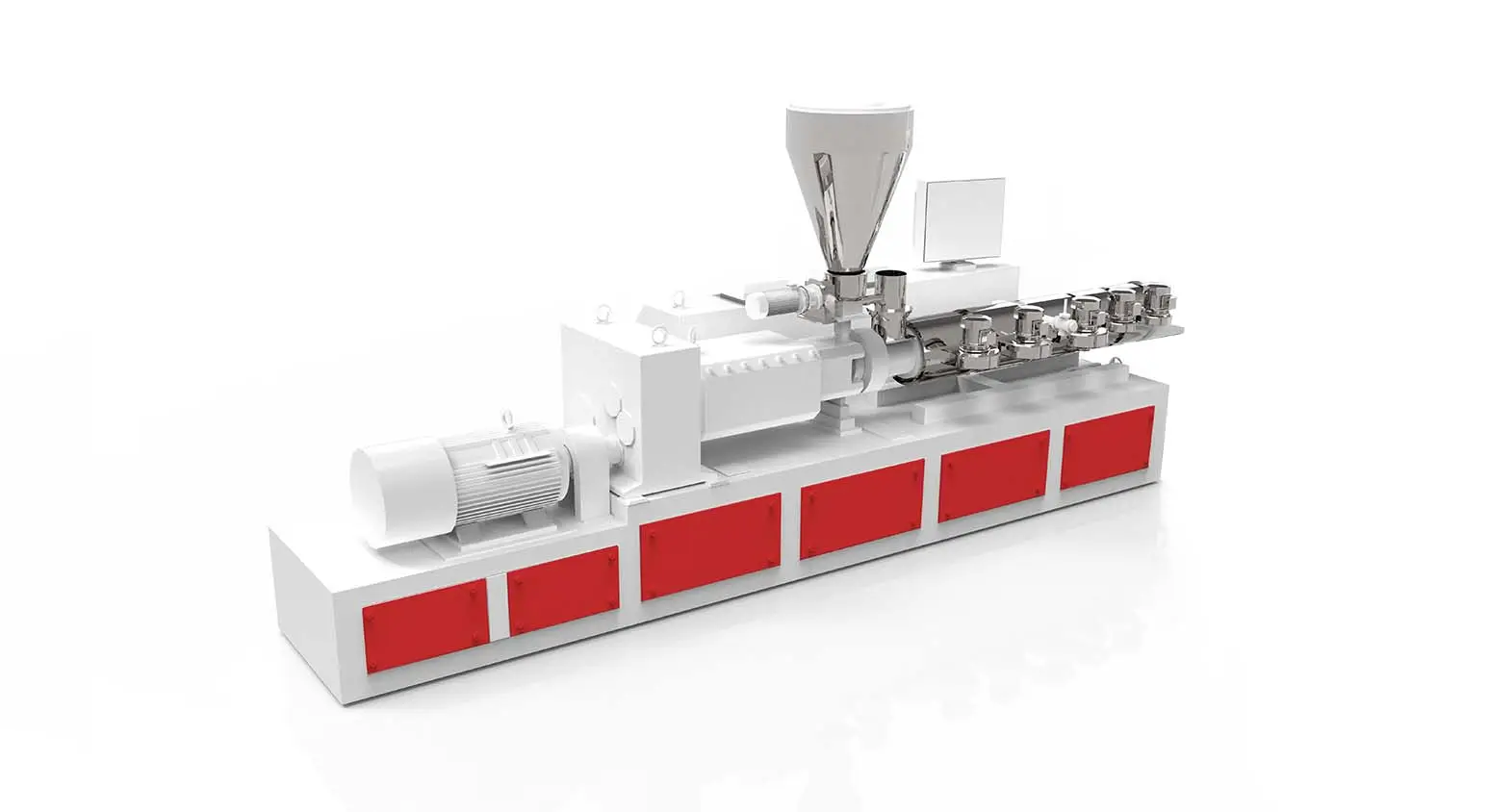
Consistent thickness is a commercial requirement, not simply a dimensional detail, when manufacturers supply SPC flooring at scale. Variations can affect downstream cutting, profiling, installation performance, and customer acceptance. For this reason, real-time measurement is becoming an important part of process control. At Boyu, we approach SPC flooring extrusion with a focus on stable output, precise thickness control, and repeatable board quality.
Why Thickness Control Matters in SPC Flooring
SPC flooring combines PVC powder, calcium carbonate, stabilizer, lubricant, and other small materials. Boyu’s specified formulation uses a main material proportion of PVC to calcium carbonate at 1:3. Because formulation and processing conditions interact, production teams need reliable process control to keep the finished board within its intended thickness range.
Our SPC flooring extrusion line is specified for products 3-9 mm thick and 1050/1350 mm wide. These dimensions give manufacturers a practical production range, but maintaining a target thickness requires more than setting a value on the control panel. Melt behavior, die conditions, calendering, cooling, and line speed can all influence the final sheet.
How Real-Time Gauging Supports SPC Production
A real-time thickness gauge measures the moving sheet during production instead of relying only on periodic offline checks. Commercial extrusion measurement systems can provide high-resolution, real-time measurements and support machine-direction and cross-direction control. This allows operators to see process variation sooner and respond before a large quantity of material becomes nonconforming.
For an SPC flooring machine, the value is especially clear when measurement data is connected with process controls. If thickness begins moving away from the target, operators can investigate extrusion output, die conditions, roll settings, or line speed. The gauge therefore becomes part of a feedback loop rather than a standalone inspection device.
Supporting Statistical Process Control
Statistical process control, or SPC, depends on collecting consistent process data and identifying variation before it becomes a quality problem. Online thickness systems can display profiles, trends, and historical information, helping production teams distinguish normal variation from an emerging process shift. Such records can also support quality reviews and production documentation.
This approach is useful for business flooring manufacturers because quality decisions need to be repeatable across shifts and production orders. Instead of depending entirely on operator judgment, teams can use measured data to establish tighter process discipline. Thermo Fisher, for example, describes extrusion measurement and control systems that combine real-time thickness measurement with data management and automatic process-control options.
Connecting Gauging With the Extrusion Process
A modern SPC flooring machine should be evaluated as an integrated production system. Boyu’s SPC line includes the extruder, T-die, calender, traction machine, cutting machine, and automatic flipping and stacking system. Each stage contributes to the final board, so thickness measurement is most useful when its results can inform the stages that influence dimensional consistency.
The measurement location also matters. A gauge positioned after relevant forming and cooling stages can provide information closer to the finished board condition. Non-contact measurement technologies are widely used for extrusion applications because they can measure moving sheet products without physically contacting the surface. The appropriate sensor technology, however, should be selected according to material, thickness, surface characteristics, and process design.
What Buyers Should Evaluate Before Integration
When specifying an SPC flooring extrusion line, buyers should look beyond the gauge itself. Measurement range should cover the intended 3-9 mm product thickness, while the scanning or sensing arrangement should suit the 1050/1350 mm production width. Data refresh rate, repeatability, calibration requirements, alarm functions, and communication with the main control system are also important evaluation points.
Integration should also support practical operator workflows. A clear interface can help production personnel identify trends, review deviations, and act on alarms without interrupting normal operations. For factories running multiple formulations or product specifications, recipe-based settings and stored quality data can further improve consistency between production orders.
How Boyu Approaches Consistent Production
Our SPC flooring extrusion line is designed around stable extrusion output, precise thickness control, and uniform board density. The published system specification lists 380V/3 phases/50Hz with DC24V, or customized conditions, and the line is CE-certified for machine fabrication and electrical components. Available equipment models range from SZJZ-80 to SZJZ-180, with capacities listed from 6-8 tons per 24 hours up to 70-100 tons per 24 hours.
These specifications give buyers a basis for matching equipment to planned production volume. The larger SZJZ-180 configuration is listed at 3000-4000 kg/h and a 4 mm linear speed of 5-9 m/min, while smaller models provide lower output for different production requirements. Final configuration should be selected according to product structure, formulation, capacity targets, and factory conditions.
Building a More Data-Driven Flooring Line
Real-time thickness gauging does not replace sound extrusion engineering. It strengthens it by turning a critical quality characteristic into measurable production data. For manufacturers investing in an SPC flooring machine, this means greater visibility into process stability and a clearer path from measurement to corrective action.
At Boyu, we combine the core equipment required for SPC flooring production with a focus on precision, stable operation, and customized production solutions. A well-integrated measurement strategy can help manufacturers reduce avoidable variation, improve quality consistency, and make better use of production data. For business buyers, those capabilities can support more predictable output and stronger long-term manufacturing performance.