
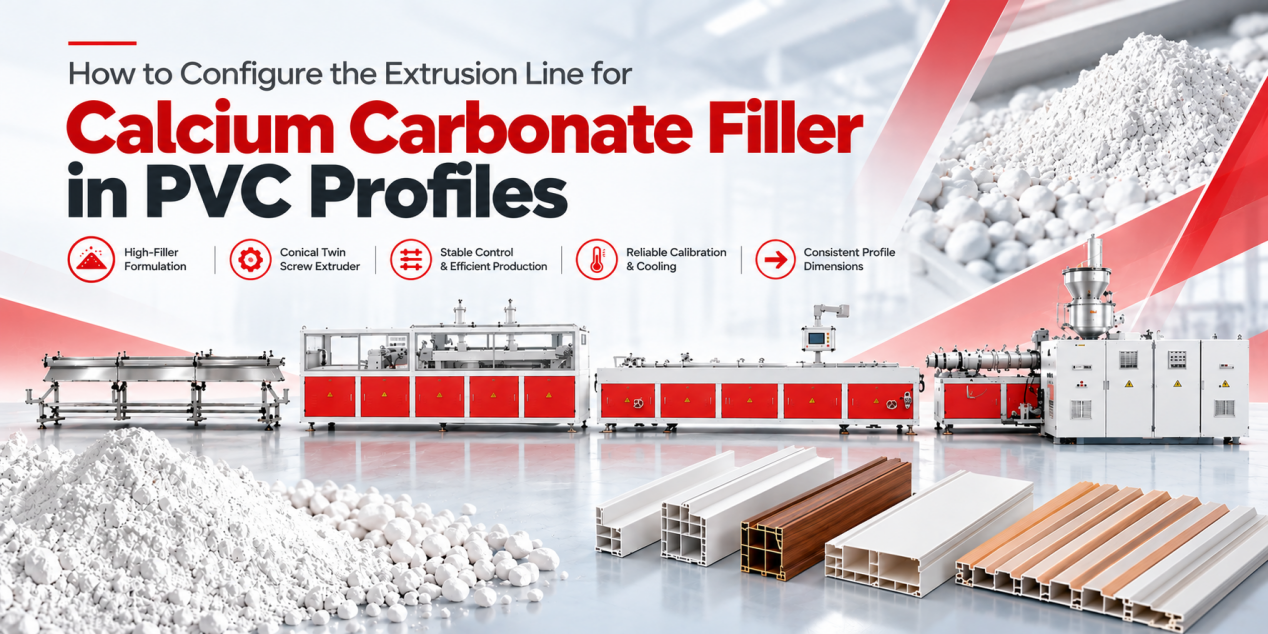
High calcium carbonate filler levels place greater demands on feeding, plasticization, drive load, wear resistance, cooling, and haul-off stability. This guide explains how to configure a PVC profile extrusion line for high-filler formulations, from selecting a conical twin-screw extruder and calculating output to matching calibration, cooling, haul-off, cutting, and PLC control. It helps manufacturers choose the right PVC extrusion machine for stable, efficient, and consistent profile production.
Establish the Design Basis for Line Selection
Record the complete dry-blend formulation using a consistent unit such as phr or weight percentage. Include the PVC resin, calcium carbonate filler content and principal additives. For the calcium carbonate grade, add its particle size and surface treatment where available. This information provides the basis for selecting the feeding method, extruder size, drive capacity, and screw and barrel configuration for the PVC profile extrusion line.
Next, prepare the profile cross-section drawing, overall width, wall thickness, cavity structure, weight per meter, target production speed and number of die outlets. Calculate the required continuous output using:
Required output (kg/h) = profile weight (kg/m) × production speed (m/min) × 60 × number of die outlets
Use the result as the design basis for determining extruder capacity and matching the downstream equipment.
Review the Feeding and Control Configuration
The hopper and feeding unit should provide sufficient capacity for the actual dry blend and target continuous output. For preliminary selection, feeder capacity can be evaluated at approximately 1.25 times the target continuous output and then confirmed through actual feeding performance and trial results.
After establishing the required feeding capacity, review how the control system coordinates the extruder and downstream equipment. The equipment proposal should specify the PLC monitoring and adjustment functions, including settings for feed rate, screw speed and haul-off speed, together with real-time monitoring of the main motor load. Centralized control and status monitoring allow each unit of the PVC extrusion line to operate in coordination with the target output.
Configure the Extruder for the High-Filler Load
For high-filler rigid PVC profiles, select a counter-rotating conical twin-screw extruder according to the actual formulation and required continuous output. Ask the equipment manufacturer to verify the target continuous output using a comparable complete dry-blend formulation, calcium carbonate grade and filler content. The trial record should include screw speed, main motor load and stable running time.
The appropriate working speed should allow the extruder to maintain the required output while retaining sufficient load capacity in the motor and gearbox. The proposal should therefore specify the continuous output range, drive power, gearbox load capacity, and screw and barrel configuration. Calcium carbonate content and particle characteristics should also be considered when reviewing component materials and maintenance requirements for the PVC extrusion machine.
Configure the Downstream Equipment as One System
Match the calibration, cooling, haul-off and cutting units to the calculated output and profile drawing. Preliminary engineering references include a calibration-table length of approximately 4–11 m, vacuum-system capability up to about −0.096 MPa and cooling-water temperatures of approximately 15–20°C.
Check the residence time in the calibration and cooling section using:
Residence time (min) = effective calibration and cooling length (m) ÷ production speed (m/min)
With an effective length of 6 m, a production speed of 2 m/min provides three minutes of residence time, while 4 m/min provides 1.5 minutes. Each planned speed increase therefore requires a coordinated review of calibration length and cooling capacity.
Profile weight per meter, contact area and production speed determine the haul-off requirement. Wider or heavier profiles may require a pulling force of 10 kN or more. A speed-stability reference of approximately ±0.5% can also be used when reviewing the drive configuration. The cutter and product support table should match the profile dimensions, production speed and required length accuracy.
Verify the Configuration Before Delivery
When project conditions permit, request a trial using the intended dry blend, die and target profile. Record the continuous output, production speed, main motor load, profile dimensions, weight per meter, cutting quality, finished-product yield and power consumption.
Estimated saleable output (kg) = rated continuous output (kg/h) × planned operating time (h) × uptime × yield
Enter uptime and yield as their decimal equivalents. For example, an uptime of 90% is entered as 0.90. Combining these records with the complete test conditions provides a practical basis for evaluating continuous production capability and estimated effective output.
Engineering reference note: The values and calculation methods above are intended for preliminary equipment selection. Project parameters should be determined from the actual dry-blend formulation, profile drawing, target output, site conditions and confirmed equipment configuration.
Further reading: How to Choose the Right PVC Profile Production Line Capacity
Configure the Line Around Your Finished Product with Boyu Machinery
Boyu Machinery develops project-specific PVC profile extrusion solutions based on your dry-blend formulation, profile cross-section, weight per meter, required output and automation level. A complete line can be configured with a conical twin-screw extruder, PLC control, profile tooling, calibration and cooling units, haul-off equipment and a cutting system.
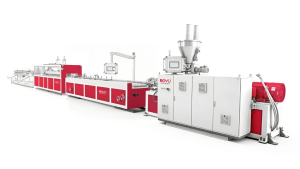
Depending on the finished product, available project configurations include:
- PVC/WPC door panel extrusion machine
- PVC door frame extrusion machine
- PVC door profile extrusion machine
- PVC ceiling panel extrusion machine
- PVC fluted panel extrusion machine
Each product has specific requirements for profile width, cavity structure, wall thickness, calibration length, cooling capacity and pulling force. Boyu Machinery matches the main extruder, tooling and downstream equipment to these parameters, allowing extrusion, calibration, cooling, haul-off and cutting to operate toward the same output target and support stable production with consistent profile dimensions.
Build a Stable High-Filler PVC Profile Extrusion Line with Boyu Machinery
Configuring a high-filler PVC profile extrusion line requires coordinated selection of the conical twin-screw extruder, tooling, calibration, cooling, haul-off, cutting, and control systems. Boyu Machinery provides complete PVC extrusion machine solutions for door panels, door frames, ceiling panels, and other profiles.
What is your calcium carbonate content, profile specification, and target output? Send us your formulation and drawing today for a tailored line configuration and quotation.