
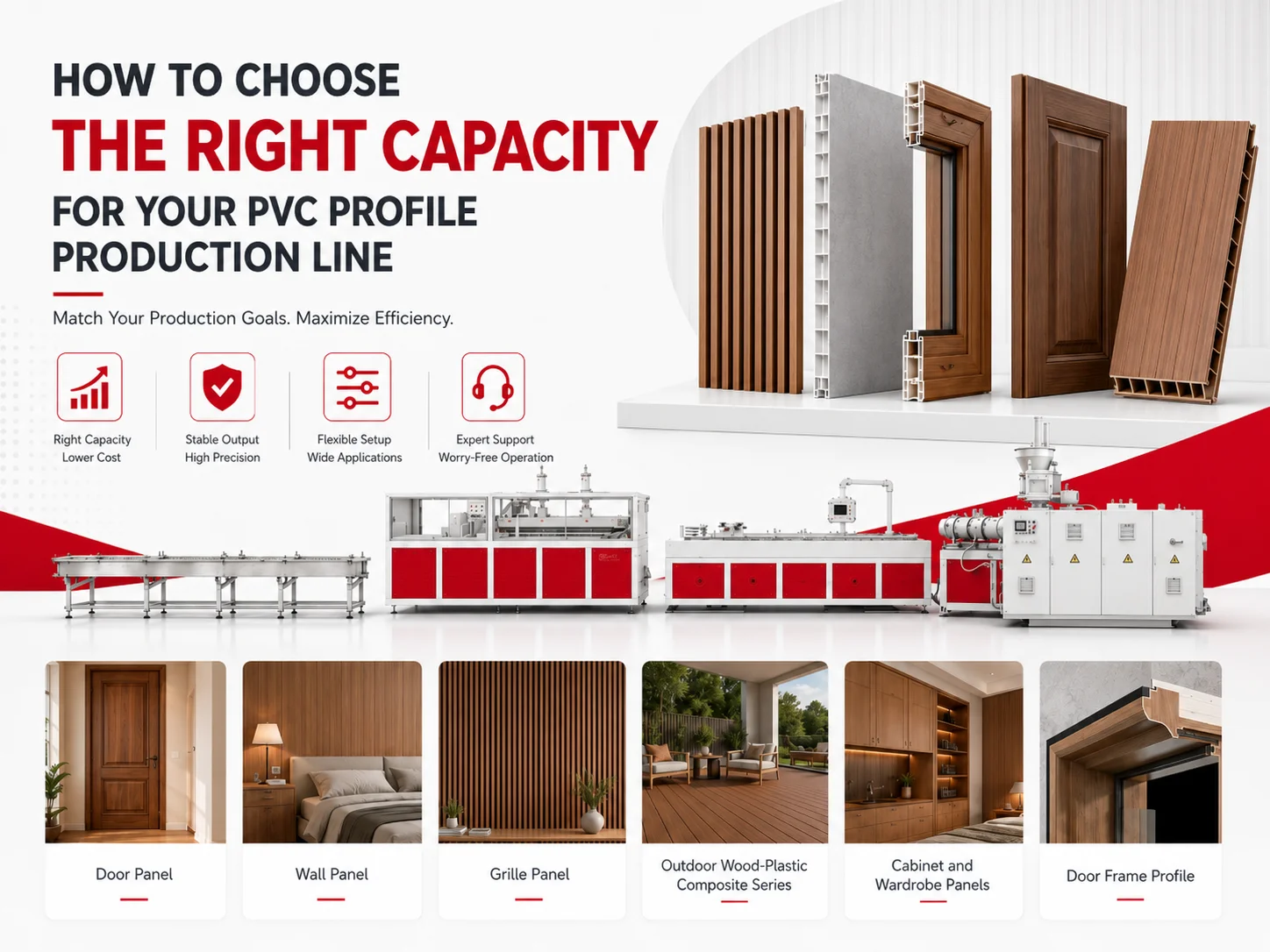
Choosing the right capacity for a PVC profile production line isn’t just about output speed — it directly affects product quality, cost efficiency, and how well your equipment keeps pace with real demand. From profile complexity and precision requirements to raw material formulation and order volume, several factors shape the right choice. This guide breaks down what to consider when evaluating capacity for your next PVC profile extrusion line.
Why Choosing the Right Capacity Matters for a PVC Profile Production Line
Selecting the right production capacity is one of the most important decisions when investing in a PVC profile production line. Getting it wrong — in either direction — can directly impact your costs and competitiveness.
Capacity Shortage
- Delayed order fulfillment, risking customer trust and repeat business
- Equipment running at full load during peak demand, increasing wear and breakdown risk
- Costly downtime and retrofitting later when expanding capacity becomes unavoidable
Capacity Surplus
- Idle equipment time, extending the return-on-investment period
- Wasted fixed costs on electricity, labor, and maintenance
- Inefficient for small orders — frequent mold/setting changes on oversized equipment reduce cost-effectiveness
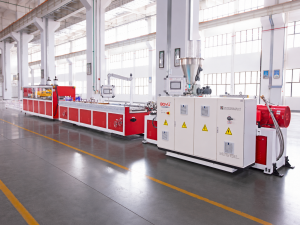
Key Factors in Choosing the Right Capacity for a PVC Profile Production Line
Capacity isn’t a one-size-fits-all decision — it depends on what you’re producing, how precise it needs to be, and how much you need to make. Here are the key factors to weigh before settling on a configuration.
Profile Section Complexity & Wall Thickness
The more complex the profile geometry or the thicker the wall section, the more material needs to be processed per cycle — so capacity should be scaled up accordingly. For simple, thin-walled profiles, a lower-capacity line can usually run efficiently at higher speeds. For intricate designs with multiple internal chambers, a higher-capacity line with more controlled extrusion is needed to maintain shape accuracy without slowing production to an impractical pace.
Precision Requirements
When surface finish and dimensional tolerance are critical, capacity should be selected with some margin below the line’s maximum rated output, rather than pushed to its upper limit. Running a line at full capacity to meet tight precision standards often leads to inconsistent wall thickness or surface defects — so for high-precision applications, it’s better to choose a line whose rated capacity comfortably exceeds your required output, leaving room for stable, controlled operation.
Raw Material Formulation
The raw material formulation should also factor into capacity selection, since it affects how fast material can be processed. Formulations with a higher filler content tend to have different melt flow characteristics, which generally reduces achievable output speed for a given PVC profile extruder size and requires more careful control of screw speed and temperature. So if your formulation is filler-heavy, it’s worth selecting a line one capacity tier higher than you would for a standard formulation, to reach the same practical output.
Order Scale & Continuity
Capacity should ultimately be sized to match real order volume and delivery frequency — not maximum theoretical output. For steady, high-volume orders, a higher-capacity line reduces per-unit cost and keeps up with continuous demand. For smaller or more irregular orders, a mid- or lower-capacity line avoids idle time and unnecessary investment. It’s also worth selecting slightly above current needs if order volume is expected to grow, to avoid a costly upgrade later.
To put these factors into context, here’s how they typically apply across common PVC profile applications — from door panels and door frame profiles to wall panels, grille panels, cabinet and wardrobe panels, and the outdoor wood-plastic composite series:
- Door Panels & Door Frame Profiles:High precision and complex sections, best matched with mid-to-large capacity lines for stable output.
- Wall Panels & Grille Panels: Decorative, batch-oriented applications; capacity can be flexibly selected based on project scale.
- Cabinet & Wardrobe Panels: Highly customized with smaller batch sizes, suited to small-to-mid capacity lines.
- Outdoor Wood-Plastic Composite Series: Typically large, continuous orders, best served by higher-capacity configurations.
Recommended reading: PVC Wall Panel Production Line: Meeting Growing Demand Through PVC Extrusion
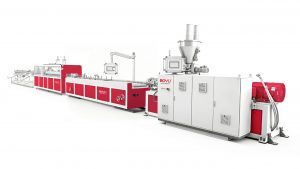
Find Your Fit: Boyu Machinery PVC Profile Production Line
Whatever your production scale, Boyu Machinery has a configuration built for it. From compact lines suited to small-batch, highly customized profiles to high-output systems built for continuous large-volume runs, the following models cover the full spectrum of capacity needs.
| Extruder Model | Main Motor Power | Hourly Capacity |
| SJSZ-48/51 | 15kw | 120KG/H |
| SJSZ-55 | 22kw | 150KG/H |
| SJSZ-65 | 37kw | 250KG/H |
The SJSZ-48/51 is well suited to smaller-batch or highly customized applications, such as cabinet and wardrobe panels, where flexibility matters more than raw throughput. The SJSZ-55 offers a balanced mid-range option for decorative products like wall panels and grille panels, where order sizes vary. For high-precision, high-volume applications such as door panels, door frame profiles, and the outdoor wood-plastic composite series, the SJSZ-65 delivers the stable, higher-capacity output these applications demand.
Beyond capacity, Boyu Machinery’s PVC profile production line stands out for several reasons:
- Proven Experience: Nearly 30years in extrusion technology, backed by 120+ patents.
- Certified Quality: CE-certified equipment built to recognized international standards.
- Stable Output:Precise temperature control and a stable forming system ensure consistent profile geometry across long production runs.
- Ongoing Support:From selection to after-sales service, Boyu Machinery provides support throughout the equipment’s lifecycle.
Choosing Capacity the Smart Way: Your Next PVC Profile Production Line
Getting capacity right comes down to matching your product complexity, precision needs, and order volume with the right equipment — and Boyu Machinery’s range of PVC profile production lines, backed by nearly 30 years of extrusion expertise, is built to support that fit, from small-batch customization to large-scale continuous output.
If you’re evaluating a new PVC profile production line, what capacity range best fits your production plans — and what’s holding you back from deciding? Share your thoughts in the comments below. For a tailored recommendation, contact us and our team will help you find the right fit.