
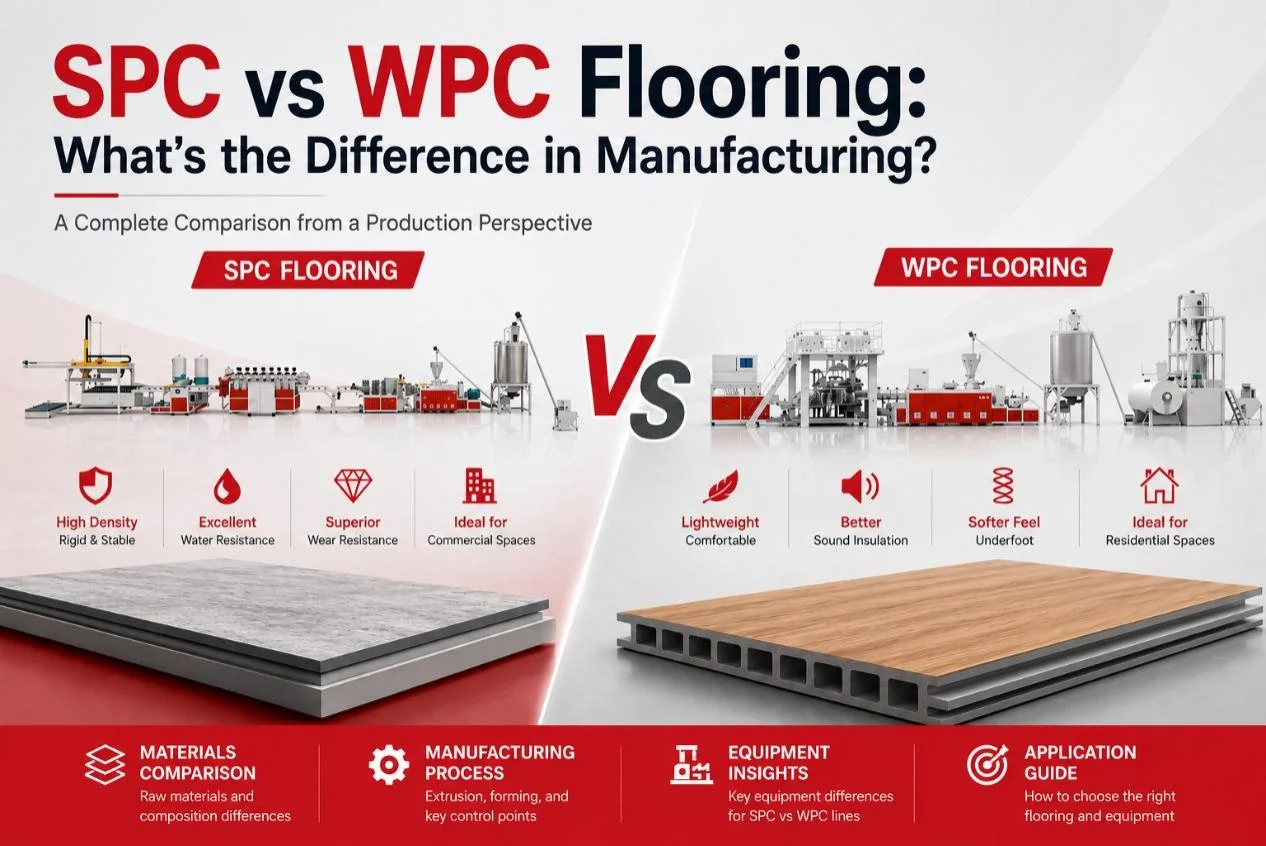
SPC and WPC are two of the most widely used rigid core flooring structures today. While they share a similar appearance, their core materials, manufacturing processes, and ideal applications differ in meaningful ways. Understanding these differences helps manufacturers and buyers make more informed decisions about products and the production lines behind them. This article breaks down the key distinctions from a production perspective.
SPC vs WPC Flooring: Key Manufacturing Differences
The divergence between these two flooring types starts at the raw material stage and carries through every step of production.
Material Composition
SPC flooring is built on three core ingredients: calcium carbonate (CaCO₃), PVC resin, and a combination of processing aids — typically including stabilizers, lubricants, and other processing aids. The formula is dense and heavy by design, with no foaming agents involved. WPC production, by contrast, uses raw materials such as PVC powder, calcium carbonate, stabilizer, lubricant, and small materials — processed with a foaming reaction that creates a lighter, cellular core structure.
Product Structure
The SPC core is typically 3.2 to 9 millimeters thick — thinner than WPC because the foamed core is less dense than SPC’s stone-filled composition. WPC flooring thickness generally ranges from 5 to 20mm, with the WPC layer serving as the main structural layer and a bottom EVA or IXPE layer providing cushioning and sound insulation.
Forming Process
SPC flooring is manufactured by extruding PVC base material through a T-shaped die using an extrusion machine. The PVC wear layer, decorative film, and base material are bonded and embossed in a single-step process using a three-roll, four-roll, or five-roll calender. WPC extrusion follows a similar co-extrusion logic but requires more precise temperature control throughout to maintain consistent foam cell structure — any fluctuation in heat zones can directly affect foam density and surface quality.
Key Process Control Points
For SPC, the critical variables are material dispersion, plasticizing performance, and flowability, due to the thin profile, small thickness tolerances, and fast extrusion speed involved. Screw wear is also a key consideration given the high filler content. For WPC, the priority shifts to foaming agent dosage and temperature control, where fluctuations directly affect foam density and surface quality.
Production Equipment
SPC lines typically center on a high-torque twin-screw extruder paired with a T-die, multi-roll calender, haul-off unit, and cutting system. WPC flooring extrusion lines share some of this architecture but add foam-specific components: specialized screws designed for foaming compounds, and tighter temperature control zones throughout.
Final Performance Comparison
| Property | SPC Flooring | WPC Flooring |
| Core hardness | High | Moderate |
| Weight | Heavier | Lighter |
| Comfort underfoot | Firm | Cushioned |
| Moisture resistance | Excellent | Very good |
| Dimensional stability | Superior | Good |
| Acoustic performance | Moderate | Better |
| Typical application | Commercial / high-traffic | Residential / light commercial |
SPC vs WPC Flooring Production Line: How to Choose the Right Equipment
Choosing between an SPC and a WPC extrusion line isn’t a single decision — it’s a series of equipment-level trade-offs that follow from your product, your volume, and your team’s process capability.
1. Extruder and Screw Configuration
An SPC flooring extrusion line, because it processes a high stone-powder formula, should be built around a twin-screw extruder with screws suited to high-filler, abrasive compounds. What you’re selecting the machine for here is uniform mixing and stable plasticizing — the line has to disperse PVC, calcium carbonate, and additives evenly to produce the dense, dimensionally consistent core that defines SPC.
A WPC flooring extrusion line is configured differently, around screws designed for foaming compounds whose geometry manages melt expansion. The machine’s job shifts from handling abrasive filler to controlling the foaming reaction evenly across the melt, which is what gives the core its consistent cell structure and lighter weight.
2. Temperature Control
An SPC flooring extrusion line is relatively forgiving on heat zones, since there’s no foaming reaction to manage — though the equipment still needs reliable heating and cooling control across all zones to keep the core consistent and dimensionally stable.
A WPC flooring extrusion line depends far more heavily on temperature precision. Every heat zone has to stay within a tight window because even small fluctuations shift foam density, cell uniformity, and surface quality. That’s why a WPC line should come with finer, more granular zone control, plus the sensors and PLC logic to hold it throughout the run.
3. Volume and Tolerances
An SPC flooring extrusion line suits high-volume, consistent-run production where throughput and dimensional precision are the priorities. The planks are thin and run fast, so the line has to deliver tight, repeatable thickness control batch after batch.
A WPC flooring extrusion line typically runs thicker stock at more moderate speeds. The emphasis is less on raw throughput and more on precise control over formula and foaming parameters, so the line should be chosen for fine process adjustment rather than maximum output.
4. Process Capability and Entry Barrier
An SPC flooring extrusion line is generally the more forgiving starting point. It’s a stable, non-foamed process whose main variables, mainly dispersion, plasticizing, and flowability, are well established and easy to control, making it a sensible entry into rigid core manufacturing.
A WPC flooring extrusion line asks more of the team running it. Foaming agent dosage and heat management have a direct effect on yield and finished quality, so it’s better suited to manufacturers with stronger process engineering capability and a line equipped to hold those parameters steady.
Further reading: What Factors Should Be Considered Before Selecting an Extrusion Line?
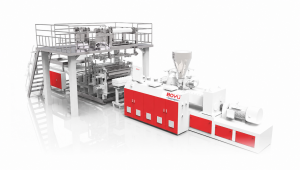
Equipment Recommendation: Boyu Machinery
At Boyu Machinery, we’ve spent years engineering extrusion solutions, and our product range reflects that depth of experience.
- Our SPC flooring extrusion line features conical twin-screw extruders with PLC intelligent control, producing planks from 3–9mm thick at capacities ranging from 6 tonnes to 100 tonnes per day — built for operations of any scale.
- For WPC production, our WPC flooring extrusion line handles thicknesses from 5–20mm across widths up to 2050mm, with fully customizable configurations to match your product spec.
Both lines run on Schneider electrical components with Omron or Siemens PLC options — the kind of reliability that matters when you’re running production around the clock.
Conclusion
SPC and WPC flooring demand different production approaches — and the right equipment makes all the difference. At Boyu Machinery, our SPC and WPC flooring extrusion lines are built to deliver on both, with proven performance across operations of every scale.
Whether you’re launching a new production line or upgrading existing capacity, our team can help you match the right configuration to your product positioning and output goals. So tell us: when producing SPC or WPC flooring, what’s the most stubborn problem on your line? Get in touch, and Boyu Machinery’s engineering team will weigh in.
References
- https://www.familyhandyman.com/article/what-is-spc-flooring-and-should-you-get-it/
- https://www.floorcasa.com/blog/spc-flooring-thickness-guide-engineering-specifications.html
- https://www.trioflor.net/news/spc-flooring-production-process-and-requirements.html
- https://www.flooror.hk/en/2025/07/03/chapter-3-what-raw-ingredients-are-used-to-produce-spc-flooring/
- https://www.cloudsflooring.com/how-is-spc-flooring-made/
- https://www.protexflooring.com/what-is-spc-flooring/