
LVT flooring production involves more than selecting the right raw materials. Understanding how each stage works, from the layered structure to the manufacturing process, is what helps manufacturers make informed decisions about equipment and quality control. This article breaks down the key components, production steps, and practical tips for better output consistency in luxury vinyl tile flooring manufacturing.
What Are the Key Structural Components of LVT Flooring?
The performance of LVT flooring comes directly from its layered architecture. Each layer serves a specific function:
- PVC Core Layer: Provides overall structural stability and ensures strong resistance to deformation under load.
- Design Layer: Uses high-precision printing technology to recreate wood grain, stone texture, and other decorative patterns with excellent visual accuracy.
- Wear Layer: A transparent protective film applied to the surface that enhances scratch resistance and extends the product’s lifespan.
- Backing Layer (Balance Layer): Helps balance internal structural stress, improves dimensional stability, and prevents warping after installation, contributing to a more reliable and long-lasting floor.
How Is LVT Flooring Manufactured?
The LVT flooring production process typically involves multiple precision-controlled stages designed to ensure consistent quality and performance.
Process 1: PVC Mixing and Raw Material Preparation
PVC resin is blended with stabilizers, plasticizers, and other additives to form a stable base formulation. This ensures consistent material properties and directly affects the flexibility and structural performance of LVT flooring.
Process 2: Extrusion and Calendering Process
The mixed material is processed through an extrusion system to form base sheets, which are then calendered to precisely control thickness and density. This step is critical in LVT flooring production, as it ensures uniform structure and dimensional stability.
Process 3: Multi-layer Lamination and Hot Pressing
Different functional layers, including the core layer, design layer, and backing layer, are combined under high temperature and pressure. This process forms a tightly bonded structure, improving durability and resistance to deformation in luxury vinyl tile flooring.
Process 4: Surface Treatment and Finishing Process
Surface treatment techniques are applied to enhance wear resistance, stain resistance, and water resistance. Through embossing, polishing, or protective coating processes, the flooring surface gains improved durability and a more realistic visual texture, ensuring better performance of LVT vinyl flooring in daily use.
Further Reading: How to Choose the Right Extrusion Line for Your Product Application?
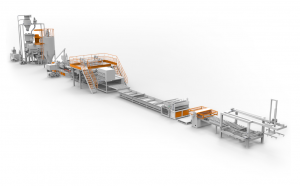
Four Keys to Better Quality and Yield in LVT Flooring Production
High-quality LVT flooring isn’t just about the right materials — it also depends on how consistently each stage of production is controlled. Here are four areas that tend to have the most direct impact on defect rates and overall yield.
1. Get the Mixing Right First
Everything downstream depends on a stable, evenly dispersed formulation. Start with the feeding sequence: stabilizers and plasticizers should be introduced at the right stage relative to the resin. From there, set mixing temperature and duration according to your specific formulation, and monitor both parameters consistently across batches to keep material properties stable.
2. Control Thickness in Extrusion and Calendering
At this stage, roll gap, roll speed, and cross-width tension all need to be set carefully and verified at the start of each run. Alongside these, monitor melt temperature continuously, as it directly affects how the material flows through the die and responds to the calender rolls. To catch variation early, check thickness across the full sheet width at regular intervals rather than only at the edges.
3. Manage Heat and Pressure in Lamination
Press temperature and dwell time should be set based on the specific thickness and composition of each product configuration. When switching between different stacks, always re-verify these parameters rather than carrying over the previous settings. In addition, check pressure distribution across the press width periodically to ensure even bonding across the full sheet.
4. Control Cooling Rate and Haul-off Tension
Set cooling water temperature and flow rate according to the sheet thickness being run, and keep these parameters stable throughout the production run. For thicker sheets, allow sufficient cooling time before haul-off to ensure the core temperature has dropped adequately. Once the sheet moves into haul-off, set tension based on the specific formulation and thickness, maintain consistency across the full width, and re-verify settings whenever line speed is adjusted.
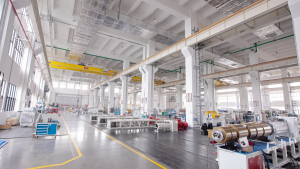
Looking for Reliable Equipment? Meet Boyu Machinery
At Boyu Machinery, we are a CE-certified extrusion line manufacturer delivering precision machinery solutions for LVT flooring production. Our equipment is engineered to handle standard PVC-based formulations and ensure consistent, high-quality output across every production run.
Key equipment advantages:
- Energy-Efficient:Reduces power consumption while maintaining high output.
- High Productivity: Optimized for maximum production capacity.
- Intelligent Control System: Ensures precise operation with user-friendly automation.
- Stable & Reliable:Designed for consistent performance with a low failure rate.
Whether you’re scaling up production or optimizing an existing line, our engineering team provides tailored solutions to match your specific output requirements.
Conclusion
Consistent output in luxury vinyl tile flooring manufacturing comes down to how well each stage is controlled. Getting the formulation right in mixing, maintaining dimensional accuracy through extrusion and calendering, managing heat and pressure in lamination, and controlling cooling rate and haul-off tension all contribute to fewer defects and better yield.
Which part of the production process has been the most challenging to get right in your operation? Leave a comment below. If you are looking for equipment support, contact us to discuss your production requirements.