

LVT flooring production is often harder than the finished product suggests. The PVC-and-calcium-carbonate compound behind every waterproof LVT flooring plank tends to be heat-sensitive, heavily filled, and difficult to process evenly.
This article looks at what makes LVT flooring production so demanding — and how the right extrusion machine line can address it.

Why Waterproof Vinyl Flooring Is So Hard to Extrude
A waterproof luxury vinyl plank flooring compound looks unremarkable, but it’s one of the more demanding materials to run on an extrusion line.
PVC Is Heat-Sensitive
PVC does not melt into a free-flowing liquid; it forms a gelled, elastic-plastic melt and is sensitive to heat. If held too hot for too long, it tends to degrade, releasing hydrochloric acid and discoloring. This leaves a relatively narrow processing window — the compound must be gelled sufficiently without being pushed into degradation — which makes temperature and shear difficult to balance once you try to lift output.
The Calcium Carbonate Loading Is High
Calcium carbonate typically accounts for a high share of the compound and does not melt at processing temperature. A heavily filled recipe, therefore, tends to run at higher melt viscosity and lower flow than unfilled PVC, generating more internal friction and shear heat. The higher the filler load, the harder it is to keep the melt flowing steadily and the sheet uniform, which often limits how fast the line can run.
The Filler Is Abrasive and Hard to Disperse
The filler is also abrasive, and over time it can accelerate wear on screws and barrels — raising maintenance and downtime if components are not built to withstand it. It must also be dispersed evenly: uneven dispersion can leave weak points in the composite and lead to inconsistent thickness and strength across the sheet.
In short, the difficulty lies less in melting the material than in mixing it uniformly within a narrow thermal window while limiting overheating and wear. Many output and quality issues on an LVT line can be traced back to one of these three points.
Recommended reading: What Are PVC Flooring Materials? A Complete Guide for Manufacturers
How Boyu Machinery’s Extrusion Line Solves These Three Problems
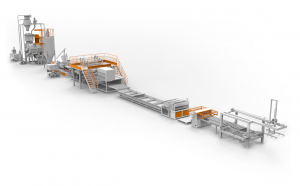
Boyu Machinery’s LVT flooring extrusion machine is built around a CE-certified twin-screw extruder — the configuration suited to a heavily filled, heat-sensitive PVC compound. Against the three challenges above, the line is specified accordingly:
- For uniform mixing and dispersion: the two intermeshing screws apply more thorough shear and kneading to the heavily filled compound, helping break up the calcium carbonate and distribute it more evenly through the melt. This reduces the weak points that come from poor dispersion and helps keep thickness and strength more consistent across the sheet.
- For stable, repeatable operation: an intelligent PLC-and-touchscreen control system manages the process for consistent running.
- For reliability against an abrasive compound: established-brand components: Schneider low-voltage electrics, Inovance, ABB,or Siemens inverters, and NSK or SKF transmission bearings, for low-failure operation.
Configured this way, the extrusion machine is designed for a PVC-to-calcium-carbonate ratio of 1:3, producing planks typically 1–3 mm thick, with width customizable to meet different production requirements. Three models are available for different output targets:
| Extruder Model | Main Motor Power | Daily Capacity |
| SJSZ-110 | 200 kW | 20–25 T/24H |
| SJSP-138 | 160 kW | 30–35 T/24H |
| SJSP-160 | 250 kW | 45–60 T/24H |
Beyond the extruder, the line runs as one complete system — covering the T-die, calender, traction machine, cutting machine, and an automatic flipping & stacking system — with full CE certification on both machine fabrication and electrical components.
Ultimately, these three challenges test not any single machine but how well the whole line works together across formula fit, process control, and component reliability — and a complete, well-matched LVT flooring extrusion line is exactly what Boyu Machinery sets out to provide.
Talk to the Engineers, Not a Brochure
When it comes to LVT flooring production, what matters most to you — output, running stability, energy use, or equipment durability? Share your thoughts, or any pitfalls you’ve run into, in the comments. And if you’d like to go further, contact us to send your formula and output targets to Boyu Machinery — our engineers would be glad to take a look with you.
References
- https://www.regomould.com/pvc-melting-point.html
- https://www.specialchem.com/polymer-additives/guide/precipitated-calcium-carbonate-center